
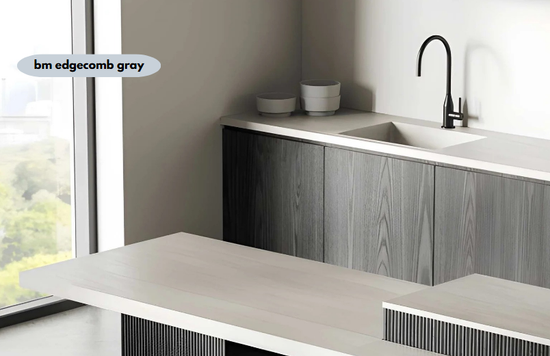
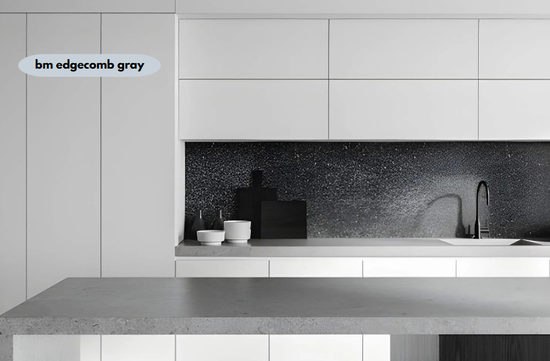
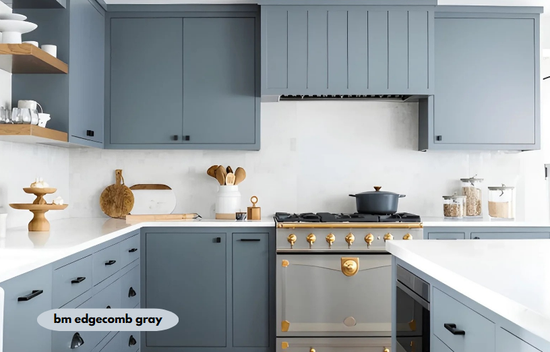
BM Edgecomb Gray (HC-173) works in kitchens as a warm greige for walls, painted cabinets, or an island because it reads soft beige-gray without turning cold. Pair it with a warm white on trim, brass or black hardware, and a deeper accent such as navy so the room never looks flat.
Key Takeaways
- Edgecomb Gray is a light, warm greige from the Historical Colors collection that leans beige in warm light and grayer in north light.
- It works best on walls when cabinets go lighter and best on cabinets when walls go lighter.
- A typical 20-door kitchen needs roughly one gallon plus one quart of cabinet enamel for two full coats.
- Warm whites, brushed brass, white oak, and navy are its most reliable kitchen partners.
- Freshly painted cabinets need about a week of curing before heavy daily use.
What Is Edgecomb Gray?
Edgecomb Gray (HC-173) is a pale, warm greige paint that blends a soft gray base with sandy beige warmth, landing between a true gray and a light taupe.
One of the more interesting facts hides in its code. The “HC” marks the Historical Colors collection, a palette rooted in shades found on older American homes, which explains why the color looks so natural beside shaker doors, beadboard, and farmhouse sinks.
Is BM Edgecomb Gray Good for Kitchen Walls?
Yes, for most kitchens. It gives walls a warm, light backdrop that hides scuffs better than white while keeping the room bright.
Its light reflectance value is 63.09, according to Benjamin Moore’s official HC-173 color page. Treat that number as a buffer: a 12-by-14-foot kitchen with one window stays bright, yet white upper cabinets still stand apart from the walls by a clear margin.
Two painting tips for walls near the range: choose eggshell or satin.
Both sheens wipe clean after a tomato-sauce splatter. Neither shows roller lap marks as badly as semi-gloss, and both hold up to weekly sponge cleaning.
How does light direction change the color?
Window direction shifts the undertone noticeably. South- and west-facing kitchens pull out the beige; north-facing rooms push it toward a quiet putty gray with a faint green cast.
Bulbs matter as much as windows. Stick with 2700K to 3000K LEDs in pendants and under-cabinet strips, because 5000K “daylight” bulbs drain the warmth and leave the walls looking chalky.
What Cabinet Colors Go With Edgecomb Gray Walls?
Warm whites, deep navy, and natural white oak pair best. Cabinets need enough difference in lightness that they stop blurring into the walls.
Use this table to judge that gap before ordering samples. The last column subtracts each value from Edgecomb Gray’s own LRV.
| Cabinet color | Best role | LRV | Gap vs. Edgecomb Gray | Source |
| White Dove OC-17 | Warm white uppers or full cabinets | 83.16 | 20.07 lighter | Benjamin Moore |
| Classic Gray OC-23 | Soft off-white, low contrast | 73.67 | 10.58 lighter | Benjamin Moore |
| Agreeable Gray SW 7029 | Near twin from another brand | 60.39 | 2.70 darker | Sherwin-Williams |
| Revere Pewter HC-172 | Slightly deeper greige | 55.05 | 8.04 darker | Benjamin Moore |
| Hale Navy HC-154 | Island or lower cabinets | 8.36 | 54.73 darker | Benjamin Moore |
Here is a working decision rule: aim for a gap of 15 points or more whenever cabinets should read as a separate element. Below 10, the eye sees one continuous color with a slight wobble, which looks like a tinting error rather than a choice. Agreeable Gray and Revere Pewter fall inside that danger zone, and Classic Gray clears it by only half a point, still short of 15.
Our core advice on designing with greige: let one element carry the contrast, whether that is a navy island, a dark range hood, or black window frames. Two or three competing contrasts make a small kitchen feel busy.
Should you paint the cabinets Edgecomb Gray instead?
Yes, as long as the walls go lighter. Cabinets in this shade look like soft linen, and they hide fingerprints far better than bright white.
Flip the table logic. Put White Dove on the walls and Edgecomb Gray on every box and door, and the 20-point difference does the work. For a two-tone plan, run Edgecomb Gray on the perimeter and Hale Navy on the island.
How Much Paint Do Edgecomb Gray Cabinets Need?
A standard 20-door kitchen needs about one gallon plus one quart of cabinet enamel for two coats. The worked example below shows where that figure comes from.
The Advance product specifications list coverage of 400 to 500 square feet per gallon. Plan with the low end, since brushing into door profiles and edges burns through paint faster than rolling a flat wall.
- Count the doors. Twenty doors at roughly 3.5 square feet per face, painted front and back, equal 140 square feet.
- Add drawers and frames. Ten drawer fronts at 1.5 square feet add 15, and face frames plus exposed end panels add about 60.
- Total one coat. That comes to 215 square feet.
- Double it for two coats. You now need 430 square feet of coverage.
- Divide by coverage. At 400 square feet per gallon, 430 requires 1.08 gallons, so buy one gallon and one quart.
Timing needs the same math. Those specs call for 16 hours between coats and 7 days before full return to service.
Backs get coats on days one and two, fronts on days three and four. Add the cure window, and the kitchen handles slammed doors and scrubbed around day 11, so schedule the project away from a holiday dinner.
The best advice from DrHomey for cabinet jobs: buy the extra quart even when your math lands close to one gallon. A second tint batch made weeks later rarely matches the first perfectly, and the difference shows on side-by-side doors.
Which Countertops, Hardware, and Accents Work Best?
Warm-veined quartz, white oak, and brushed brass flatter this color most. Cool, busy granites with heavy blue or green flecks fight its beige side.
Neutral palettes still dominate: 96% of professionals surveyed for the National Kitchen & Bath Association’s 2026 Kitchen Trends Report named neutrals the most popular kitchen colors. If you plan to sell within five years, that tilt favors neutral walls and cabinets, and it pushes the bolder spending toward a backsplash or island you can swap later.
Accent ideas that work:
- Brushed or unlacquered brass pulls add warmth that echoes the beige undertone.
- Matte black hardware sharpens a modern farmhouse look.
- Clay-toned zellige or terracotta tile repeats the sandy base without competing.
- A pitcher of Mexican flowers such as marigolds, zinnias, or dahlias throws saturated orange and magenta against the muted walls, adding seasonal color with zero commitment.
Keep accents inside the same warm family as the walls. One cool element, such as a stainless range, is plenty.
The color also bridges rooms. Carry it into an adjoining dining area or mudroom, and the kitchen reads as part of one floor plan instead of an island of color.
What Mistakes Make Edgecomb Gray Look Wrong?
Three errors cause most regrets: judging a tiny chip, pairing it with stark cool white, and ignoring the floor.
- Tiny chip. A 2-inch swatch on a bright card exaggerates the gray. Paint a 2-by-2-foot board instead, move it to every wall, and check it at 9 a.m., 2 p.m., and after dark.
- Cool white trim. Blue-leaning whites make Edgecomb Gray look dingy. Switch the trim to a softer warm white.
- Orange floors. Red-toned oak drags the walls toward pink-beige. Counter it with a gray-blue rug or a deeper island color.
Each fix follows the same interior design principle: judge a paint color against the fixed materials around it, never in isolation.
When Does Edgecomb Gray Not Work?
It fails in a north-facing kitchen with dark wood cabinets and a single small window. In that room, Edgecomb Gray loses its warmth and reads as flat, greenish putty, because no wall color can manufacture the daylight the space never receives. Homeowners who used a warm greige in their exterior design often want the kitchen to match, but the better move here is Classic Gray on the walls, with Edgecomb Gray confined to lower cabinets where under-cabinet lights hit it directly.
FAQ
Is Edgecomb Gray warm or cool?
Edgecomb Gray is a warm neutral that sits between beige and gray. South light and 2700K bulbs bring out its warmth, while north light cools it toward putty.
Does Edgecomb Gray go with white cabinets?
Yes, Edgecomb gray walls pair well with warm white cabinets. Skip stark blue-whites, which make the walls look muddy by comparison.
Is Edgecomb Gray too dark for a small kitchen?
No, it is light enough for most small kitchens with at least one window. In a windowless galley, test a large sample board first or step up to a paler off-white.
What sheen works best for Edgecomb Gray cabinets?
Satin or semi-gloss works best for painted cabinets. Satin hides brush marks better, and semi-gloss wipes cleaner beside the stove.
What is the most useful tip before choosing Edgecomb Gray?
Test the color at full scale in your own kitchen light before committing to a full room. A board viewed morning, afternoon, and night prevents most repaint jobs.
Conclusion
BM Edgecomb Gray earns its spot in American kitchens because it warms walls without yellowing and softens cabinets without looking dated. Pair it with a warm white, brass, and one deep accent, then test it in your own light before buying gallons. That approach, which DrHomey applies to every neutral kitchen, turns a safe color into a deliberate one.