
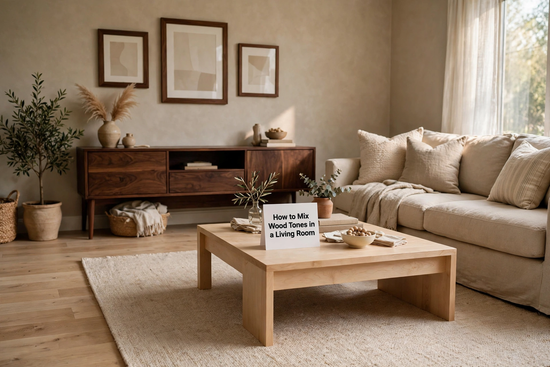
Learning how to mix wood tones in a living room comes down to a few simple moves: choose one dominant wood, match undertones rather than exact colors, and repeat every tone at least twice. Add a rug or textile buffer between the floor and furniture so contrasting woods look planned.
Key Takeaways
- A balanced living room uses one dominant wood tone and no more than two supporting tones.
- Undertone, whether warm, cool, or neutral, matters more than how light or dark a wood looks.
- Woods that differ clearly in depth look intentional, while near-matches look like mistakes.
- Every wood tone should appear at least twice in the room so it reads as part of the plan.
- Rugs, wall color, and warm lighting act as buffers that let contrasting woods sit together.
What Does Mixing Wood Tones Mean?
Mixing wood tones means combining floors, furniture, and accents made from different species or finishes in one room so the variety looks deliberate rather than accidental.
Good interior design treats wood as a color family rather than a single color, and that mindset makes mixing far less stressful. Few homeowners buy every piece at once, so the real job is making inherited, bought, and built-in pieces agree.
How to Mix Wood Tones in a Living Room, Step by Step
Start with the largest wood surface, identify its undertone, then add pieces that either contrast clearly or share that undertone.
1. Name Your Dominant Wood
The dominant wood is whichever covers the most square footage, which is usually the floor.
With wall-to-wall carpet, the biggest case piece, such as a bookcase or media console, takes that role. Every other wood in the room answers to this one, which is why The most reliable advice on designing a mixed-wood room always begins with this single choice.
2. Test the Undertone Before You Buy
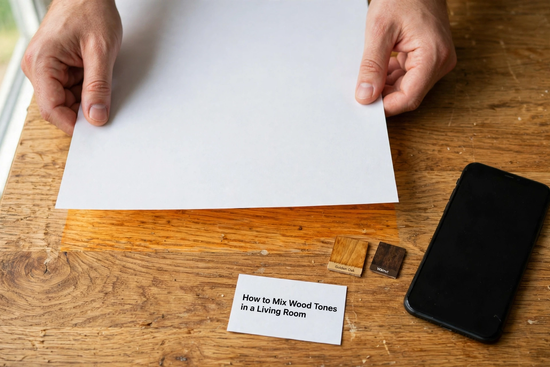
Undertone is the color beneath the obvious brown, and it decides whether two woods get along. A sheet of paper reveals it:
- Hold white printer paper flat against the wood in natural daylight.
- Watch the edge where paper meets wood: orange or yellow signals warm, red or pink signals red-warm, and gray or green signals cool.
- Photograph each piece beside the sheet to compare in stores.
- Group pieces by undertone and keep the warm and cool groups apart.
Gray-washed oak beside orange pine is where rooms start to feel wrong.
3. Contrast Clearly, Never Almost-Match
Choose woods that are obviously lighter or obviously darker than the floor. Use the squint test below to check.
A honey oak table on a honey maple floor looks like a failed match. Squint at the two woods; if they blur into one color, they are too close.
4. Repeat Each Tone at Least Twice
A lone walnut piece in a room of pale oak reads as an orphan, so give it a partner across the room.
A walnut frame or lamp base works. A bridge piece works even better: a two-tone table, a striped rug, or a print that contains both the light and the dark wood color tells the eye the two tones belong together.
Which Wood Tones Go Together?
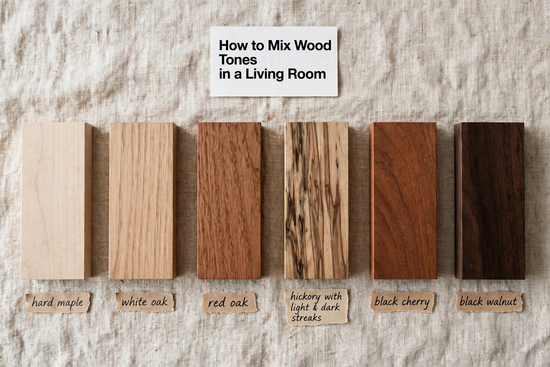
Woods that share an undertone pair easily, and woods with strong depth contrast pair well even across undertones when a neutral sits between them.
| Species | Typical finished tone | Undertone | Pairs well with | Janka hardness (lbf) | Source |
| Red oak | Light to medium tan | Warm, pink-red | Walnut, black-stained wood | 1,290 | Bruce (AHF Products) |
| White oak | Light to medium beige | Neutral to cool | Walnut, cherry, maple | 1,360 | Bruce (AHF Products) |
| Hard maple | Pale cream | Warm, yellow | Walnut, white oak | 1,450 | Bruce (AHF Products) |
| Hickory | Light and dark streaks | Warm | Solid dark woods, painted pieces | 1,820 | Bruce (AHF Products) |
| Black cherry | Reddish brown, darkens with age | Warm, red | White oak, maple | 950 | Bruce (AHF Products) |
| Black walnut | Deep chocolate | Warm to neutral | Nearly any lighter wood | 1,010 | ToolsToday |
White oak and cherry break the undertone rule but still work, because the depth contrast between pale oak and reddish cherry is strong enough to look intentional.
Hardness shapes placement, too. Walnut rates about 30% softer than hard maple on the Janka scale. In a tight space every piece gets bumped, so if you’re working out how to choose furniture for a small living room,give the coffee table to a harder species like maple or hickory and save walnut for shelves and frames.
5. Match Grain Weight, Not Just Color
Grain pattern carries as much visual weight as color does.
Busy, open grains like oak and hickory pair best with quiet, tight grains like maple or cherry. Two bold wood grains together clash.
6. Cap the Room at Three Wood Tones
A dominant, a secondary, and an accent keep a room layered without chaos. Painted and upholstered pieces don’t count.
Match sheen as well as color. A matte oak floor beside a high-gloss lacquered table looks mismatched even when the browns agree, so keep most pieces in satin or matte and save gloss for one small accent.
7. Let the Wall Color Referee
A greige or soft warm neutral on the walls bridges warm and cool woods. Sherwin-Williams’ Universal Khaki (SW 6150), its 2026 Color of the Year, is a good example of this family. Swatch a tan in that family beside your lightest and darkest wood before buying a gallon.
How Do You Balance Wood Tones in a Small Living Room?
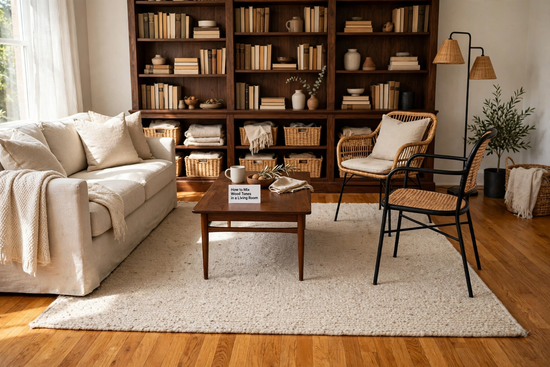
Use a rug to keep clashing woods apart, and choose fewer, larger wood pieces so a compact room stays calm.
8. Use a Rug as a Buffer
A rug breaks contact between floor wood and furniture legs, where mismatches show most.
Take a 12-by-15-foot room with 180 square feet of floor. An 8-by-10 rug covers 80 square feet, or 44%, and puts a neutral field under the sofa, table, and chairs. A 5-by-8 rug covers just 40 square feet, about 22%, leaving most legs on bare oak.
9. Choose Fewer, Bigger Pieces in Small Rooms
A small room handles two wood tones better than three.
Layout matters as much as color here, and once you know how to arrange furniture in a small living room , balancing the wood mix gets much easier. Push the heaviest wood piece against the longest wall and keep the center open. Raised legs show the floor underneath and make dark wood feel lighter, while glass, rattan, or metal accents add texture without introducing another wood tone.
How Do You Mix Wood Tones in an Open Floor Plan?
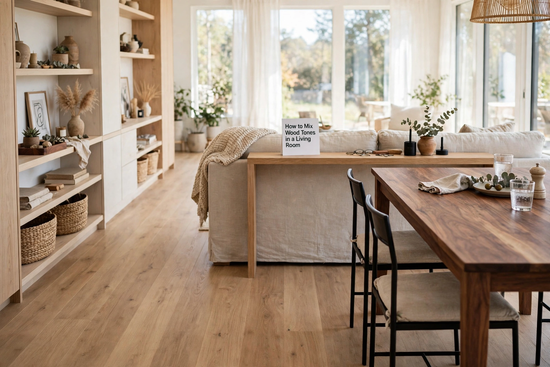
Treat the shared floor as the dominant wood, give each zone its own secondary tone, and echo one piece across the boundary.
10. Assign One Tone per Zone in an Open Plan
Each zone gets one secondary wood, and the border between zones does the separating.
Picture a walnut dining table in the eating zone and white oak shelving in the living zone, with a sofa back or console marking the border between them. It’s one of the simplest open floor plan furniture arrangement ideas, and it works because each zone tells its own clear wood story. Carry one small piece across, such as a walnut tray on the oak shelf, so the zones still connect.
Check the view from the front door. Whatever wood you see first in each zone should be that zone’s secondary tone, never a surprise fourth one.
Can Mixed Wood Make a Living Room Warmer in Winter?
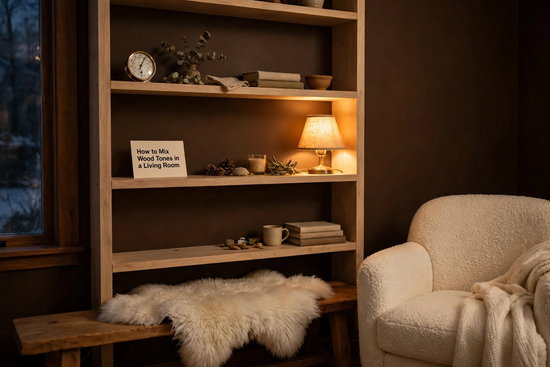
Yes. Darker woods, warm lighting, and textiles make a mixed-wood room feel cozier once daylight drops.
11. Add One Dark Accent for the Cold Months
If you’re wondering How to make a room feel cozy and warm for winter , start with one deep, dark element set against lighter furniture. Benjamin Moore named Silhouette AF-655, an espresso brown with charcoal depth, its 2026 Color of the Year in its October 2025 announcement. Paint one wall in a shade like that behind pale oak shelving, and the lighter wood glows by contrast.
12. Light Your Woods With Warm Bulbs
Warm white bulbs, labeled around 2700K, pull the amber out of oak, cherry, and walnut.
Cool “daylight” bulbs push the same woods toward gray. Drape wool, boucle, or sheepskin over wood chairs and benches; soft texture against hard grain keeps a wood-heavy room from feeling stiff.
What Are the Most Common Wood-Mixing Mistakes?
The most common mistake is buying a piece that almost matches the floor. Store lighting makes samples look close, so commit to contrast.
Another is letting clashing undertones touch. Slide a painted piece, metal stand, or basket between them.
A third mistake is forgetting that wood changes color in sunlight. Cherry darkens with light exposure, oak tends to amber, and walnut often lightens, so a pair that matched in the showroom drifts apart beside a sunny window. Keep light-sensitive pieces out of direct sun, or build in contrast wide enough to survive the shift.
Comprehensive guidesto wood furniture care all agree on one more factor: climate. Dry winter air can open pale gaps along veneer edges and joints. The U.S. Environmental Protection Agency advises keeping indoor relative humidity levels at 30–50%. Keep a hygrometer near your best wood pieces and run a humidifier whenever it reads below the lower figure.
When Should You Avoid Mixing Wood Tones?
One exception overrides most of these tips. Very dark floors, such as ebony-stained oak, look best with almost no other wood, because medium-tone furniture turns dusty against them. Switch to painted, upholstered, or metal pieces and limit wood to one light accent, like a maple tray.
FAQ
Can you mix light and dark wood furniture in the same room?
Yes, light and dark wood work together when the contrast is strong and each tone appears at least twice. A neutral rug between them helps.
Should wood furniture match the wood floor?
No, furniture should contrast with the floor rather than match it. Species and stains age at different rates, so an exact match rarely holds.
How many wood tones are too many in one room?
More than three distinct wood tones usually overwhelm a living room. Painted and upholstered furniture doesn’t count toward that number.
Do warm and cool wood tones go together?
Warm and cool woods go together when a neutral element separates them. A greige wall, wool rug, or black metal hardware creates enough distance.
What wood tone goes with everything?
Dark walnut is the most flexible wood tone for a living room. Its deep color and warm-to-neutral undertone contrast cleanly with almost every lighter species.
Conclusion
Once you know how to mix wood tones in a living room, the job becomes less about matching and more about managing contrast, undertone, and repetition. Pick one dominant wood, add no more than two supporting tones, and let rugs, walls, and warm light handle the blending.