

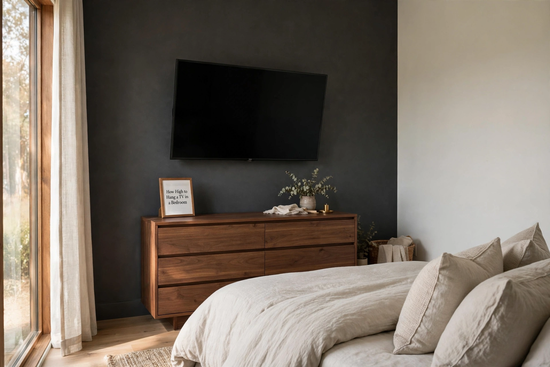
For most beds, the answer to how high to hang a TV in a bedroom is a screen center about 50 to 60 inches off the floor, placed above your eye line as you sit propped on pillows. Tilt the screen downward until it faces your pillow.
Quick formula: screen center = your eye height in bed + (distance to wall in feet × 1 inch). Most bedrooms land between 50 and 60 inches.
Key Takeaways
- A bedroom TV hangs higher than a living room TV because a mattress lifts your eyes and you recline to watch.
- Your eye height, measured while propped on your usual pillows, is the starting point for every calculation.
- Each foot between your eyes and the wall adds about 1 inch of height for a propped-up posture and about 2 inches when you lie nearly flat.
- A tilting mount set to match your upward gaze keeps the screen square to your eyes and cuts glare.
- A screen hung for bed viewing sits too high for desk work.
What Is Bedroom TV Mounting Height?
Bedroom TV mounting height is the distance from the finished floor to the center of the screen, chosen so a person in bed watches with a relaxed neck instead of a craned one.
How High to Hang a TV in a Bedroom When You Watch From Bed?
Hang it so the screen’s center sits 5 to 12 inches above your eye level while you lean back on pillows; the farther the wall, the higher it goes, and mattress height sets the starting point.
The American Academy of Sleep Medicine’s 2025 Sleep Prioritization Surveyfound that 50 percent of American adults use a screen, such as a TV, phone or tablet, in bed every day. If your nightly screen is the TV, 45 minutes a night adds up to more than 270 hours a year, and a badly placed screen means all of those hours with your chin lifted.
The same organization advises powering down screens 30 to 60 minutes before sleep, so set your TV’s sleep timer and switch to a warm picture mode at night
Why does the living room rule fail in bed?

Most interior design charts for TV height assume you sit upright on a sofa; in bed, your eyes start higher and your head leans back.
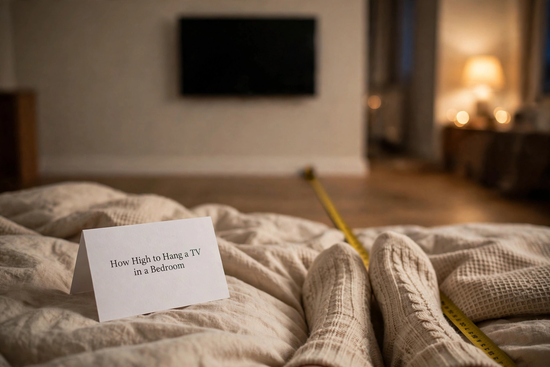
The common error is measuring eye height while standing or perched on the mattress edge. Lie in your real viewing position, pillows and all, and have someone measure from floor to eye.
How Do I Calculate the Right TV Height for My Bed?
Add a small lift to your propped eye height: wall distance in feet times an inch factor tied to how far you recline.
- Measure from the floor to the top of the mattress, including any topper.
- Get into your normal viewing position and measure floor-to-eye height.
- Measure from your eyes to the wall where the TV will hang, in feet.
- Pick a posture factor: 0 inches per foot sitting upright, 1 inch propped on pillows, 2 inches lying nearly flat.
- Multiply the distance by the factor and add the result to your eye height. That total is your screen center.
- Subtract half the TV’s height to find the bottom edge, then measure from the TV’s top edge to its mounting holes to mark the bracket.
When you recline on pillows, a gentle upward glance of about 5 degrees keeps your neck relaxed; looking straight ahead or higher makes you lift your chin. The factors come from trigonometry: a 5-degree upward gaze rises about 1.05 inches per foot.
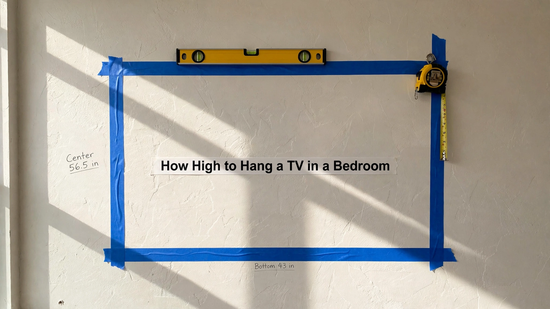
Before drilling, try one of the most useful tips by DrHomey: tape the TV’s outline on the wall with painter’s tape, then watch an episode from bed and adjust until your neck stays loose.
What does the math look like in a real bedroom?
A propped-up viewer in an average room ends up with a screen center near 56 inches.
Cedreo lists the average U.S. bedroom at 11 by 12 feet. With the headboard on an 11-foot wall, 144 inches separate it from the far wall; your eyes rest about 2 feet out, leaving roughly 10 feet.
Take a 25-inch mattress, and eyes are 21 inches above it: eye height is 46 inches. Ten feet times 1.05 inches adds 10.5 inches, so the center goes at 56.5 inches. A 55-inch TV stands about 27 inches tall, so its bottom edge sits near 43 inches.
Screen-center height by mattress height and viewing distance (propped on pillows)
| Distance | 18″ mattress | 22″ mattress | 25″ mattress | 28″ mattress |
| 8 ft | 47.5″ | 51.5″ | 54.5″ | 57.5″ |
| 10 ft | 49.5″ | 53.5″ | 56.5″ | 59.5″ |
| 12 ft | 51.5″ | 55.5″ | 58.5″ | 61.5″ |
Assumes eyes sit about 21 inches above the mattress when propped up.
What Size TV Fits the Distance From My Bed?
Pick the screen from the distance, not the reverse. At 8 to 10 feet, the relaxed range runs from about 48 to 80 inches.
| Eyes-to-screen distance | Relaxed range (seat at 1.5–2× diagonal) | 30-degree field of view size | 40-degree field of view size |
| 6 ft (72 in) | 36–48 in | 43 in | 60 in |
| 8 ft (96 in) | 48–64 in | 58 in | 81 in |
| 10 ft (120 in) | 60–80 in | 72 in | 101 in |
| 12 ft (144 in) | 72–96 in | 86 in | 121 in |
Sources: relaxed viewing ranges from Sound & Vision; 30-degree and 40-degree targets follow SMPTE and THX guidelines.
The field-of-view columns are cinema immersion targets; the relaxed column reflects everyday comfort. The 40-degree size overshoots the top of the relaxed range by 12 inches at 6 feet and by 25 inches at 12 feet.
That’s why Interior design by DrHomey sizes bedroom screens from the relaxed column: an oversized panel floods a dark room with light and overwhelms a small space.
Should a Bedroom TV Go on a Tilting or Fixed Mount?
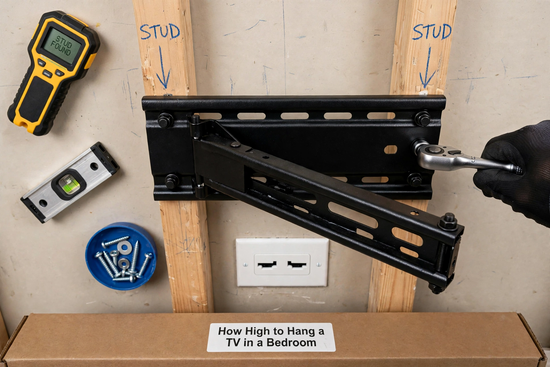
Choose a tilting mount for almost every bedroom, because a screen above eye level must angle down to face you.
Set the tilt to match your gaze: roughly 5 degrees for a propped posture and 10 degrees for near-flat viewing. VA-type LCD panels lose contrast quickly off-axis; OLED and IPS panels hold up better, but the tilt still cuts lamp glare.
Fasten the bracket into at least two wall studs, and confirm its VESA pattern and weight rating match your TV. Hide cables with an in-wall power kit built for TV mounting, never a plain extension cord pushed behind drywall.
What wall color works behind a bedroom TV?
A dark, matte wall hides the black rectangle and keeps lamp light off the glass.
Some of the best home color schemes for small spaces do double duty here: a charcoal or deep navy accent wall behind the TV hides the screen when it’s off and cuts reflections while you watch, while pale side walls keep a compact room from feeling boxed in. Choose a flat or eggshell finish there, because satin and gloss bounce light back at the screen.
Can a Bedroom TV Double as a Home Office Screen?
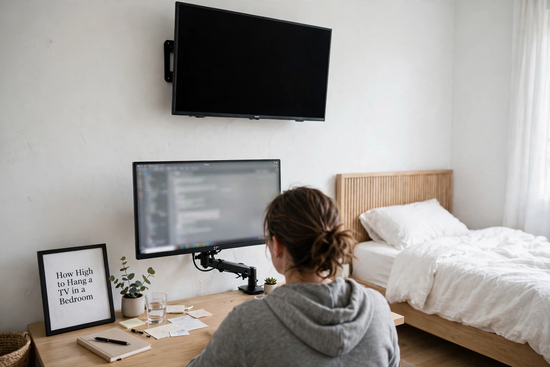
Rarely, because the bed-viewing height sits well above comfortable desk-work height.
OSHA’s Computer Workstations eTool advises placing the center of a computer monitor 15 to 20 degrees below horizontal eye level. With desk eye height at 46 inches and a screen 30 inches away, a 15-degree drop puts the center near 38 inches, about 18 inches below the bed-viewing center above.
If you need a workspace too, the smartest home office ideas for a small bedroom use a separate 24- or 27-inch monitor on a clamp arm so the TV and the monitor each sit at their own correct height.
When Does the Usual Height Advice Not Apply?
An adjustable power base breaks the formula because the head section shifts your eyes differently each night. For these beds, DrHomey advice on designing around one is simple: measure eye height at the setting you use most, then choose a full-motion mount so you can retune the angle. Low platform beds under 16 inches tall push the other way and can drop the ideal center below 50 inches.
FAQ
Is 60 inches too high for a bedroom TV?
Not always. A 60-inch center suits tall beds (eye height around 50 inches) or viewers 12 feet or more from the wall. At 10 feet with an average bed, the formula lands closer to 56 inches. If your own math lands near 50 inches, a 60-inch center will strain your neck.
How far should the bed be from the TV?
Most bedrooms leave 8 to 10 feet between the viewer’s eyes and the screen. That gap sets both screen size and mounting height.
Should a bedroom TV hang higher than a living room TV?
Yes, a bedroom TV usually hangs several inches higher because a mattress lifts your eyes above sofa level. Bed height and pillow stack decide the gap.
Can I mount a TV above a dresser in a bedroom?
Yes, as long as the screen center still matches the height your bed measurements produce. Leave at least 6 inches between the dresser top and the TV’s bottom edge, and keep decor shorter than that gap.
What type of mount works best for watching TV in bed?
A tilting mount works best for straight-on viewing from bed. Pick a full-motion for a side wall or corner so you can swing it toward the pillows.
Conclusion
How high to hang a TV in a bedroom comes down to one measured number: your eye height while propped in bed. Add about an inch for every foot of distance, tilt the screen to match, and most setups finish with a center between 50 and 60 inches.



Pingback: How High to Hang Pictures Above a Couch: The 6–10 Inch Decorating Rule Interior Design Drhomey