
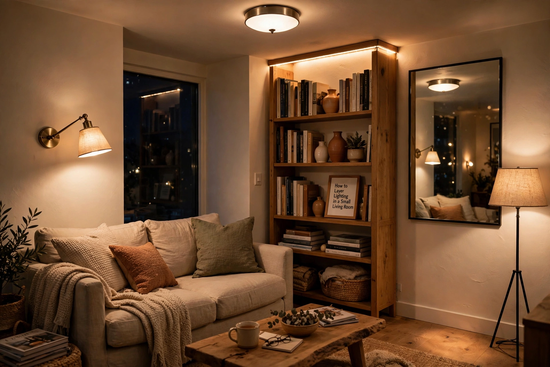
Learning how to layer lighting in a small living room means combining soft ambient light that fills the space, focused task light where you read, and accent light that draws the eye to walls and corners. Put each layer on its own dimmer so brightness shifts with the hour.
Key Takeaways
- A small living room needs at least three light sources at different heights, not one bright ceiling fixture.
- A workable target is about 20 lumens per square foot across all layers, so a 12-by-12-foot room needs roughly 2,900 lumens.
- Warm white bulbs between 2700K and 3000K keep a compact room cozy, while mixed color temperatures look patchy.
- Light aimed at walls and ceilings makes a room read as larger than light aimed at the floor.
What Is Layered Lighting?
Layered lighting is a plan that stacks ambient, task, and accent sources at different heights so no single fixture carries the whole room.
In interior design, each layer has one job: ambient light sets the base level, task light handles close work, and accent light builds the contrast that pushes walls visually back.
How to Layer Lighting in a Small Living Room?
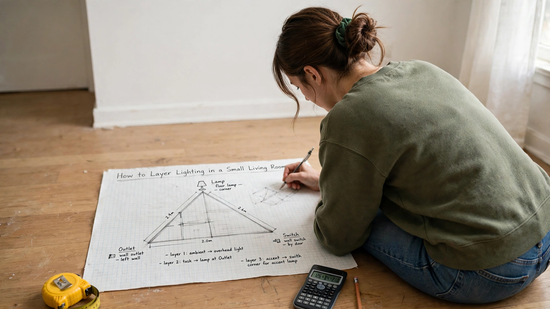
Start with the ceiling and walls, add light where your eyes do close work, then finish with highlights. Built in that order, each fixture earns its floor space.
RentCafe’s 2026 analysis of Yardi Matrix data puts the average new one-bedroom at 735 square feet, roughly 175 square feet below the 910-square-foot average for all new apartments completed in 2025. Subtract a bedroom, kitchen, and bath, and the living area often lands near 150 square feet.
- Find square footage by multiplying the room’s length and its width.
- Multiply that number by 20 to set your lumen budget.
- Give about half to ambient light, 30% to task light, and 20% to accent light.
- Sketch every outlet, switch, and ceiling box before buying anything.
- Place lamps in a loose triangle so light reaches every corner.
Lighting is the smart first step when you’re planning how to decorate a small apartment because outlet and lamp positions decide where the sofa, rug, and shelves can go.
How Many Lumens Does a Small Living Room Need?
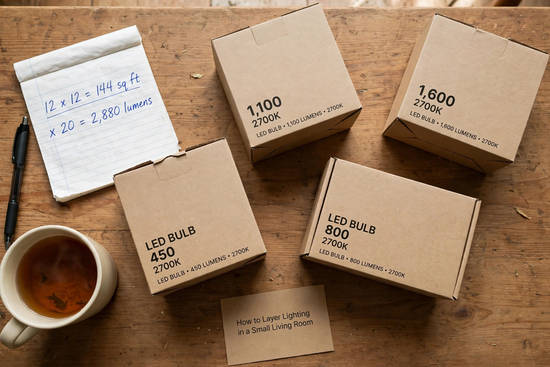
Plan for roughly 20 lumens per square foot across every layer combined. A 12-by-12-foot room covers 144 square feet, so it needs about 2,880 lumens.
| Lumens on the box | Old incandescent, it replaces | Best job in a small living room |
| 450 | 40 watts | Sconce, shelf light, or accent lamp |
| 800 | 60 watts | Reading lamp or one ceiling fixture socket |
| 1,100 | 75 watts | Floor lamp doubling as ambient light |
| 1,600 | 100 watts | Torchiere bouncing light off the ceiling |
Source: ENERGY STAR Light Bulb Purchasing Guide
Worked example: a 144-square-foot room
A real plan lands close to budget. A flush mount with two 800-lumen bulbs, one 800-lumen reading lamp, and two 450-lumen sconces totals 3,300 lumens, about 15% over target.
That splits roughly 48% ambient, 24% task, and 27% accent, close enough to the 50/30/20 guide to work. If the edges feel too bright, drop one sconce: the total falls to 2,850 lumens, right on budget.
Assume roughly 10 watts per 800-lumen LED and 5 watts per 450-lumen LED, so the setup draws 40 watts against 260 for matching incandescents. According to the U.S. Energy Information Administration’s August 2026 Short-Term Energy Outlook, homes will pay an average of 18.27 cents per kilowatt-hour across 2026. At five hours a night, the LED room costs about $13.34 a year versus $86.69 for incandescents, so plug in your own utility rate to see your exact gap.
The mistake that makes small rooms shrink
The most common error is one bright ceiling fixture at full power. Builders install a single ceiling box, owners trust it, and the flat light leaves dark corners that pull the walls inward.
The fix is simple: dim the ceiling fixture to about half and move the rest of the light into lamps and wall lights at eye level. It’s one of the most effective lighting tips for compact rooms because it erases dark corners without adding a single fixture.
Which Ambient Lighting Ideas Make a Small Room Feel Bigger?
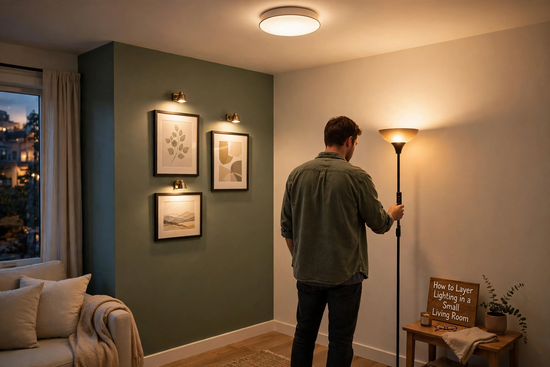
Ambient light makes a room feel bigger when it reaches the ceiling and upper walls. Bright vertical surfaces read as distance.
1. Swap a dome for a low-profile flush mount.
A slim, wide flush mount spreads light across the ceiling instead of dropping a hot spot in the middle.
2. Bounce light with a torch lighter.
An uplighting torchiere turns a pale ceiling into one huge soft reflector, which suits rentals without a ceiling box.
3. Wash one wall with light.
Picture lights grazing a single wall pushing it visually backward. Pick the wall opposite the doorway.
4. Hide LED tape above tall furniture.
Warm LED tape on top of a bookcase throws a glow across the ceiling. Because it needs only an outlet and a few adhesive clips, it’s one of the easiest cozy living room ideas on a budget, and it installs in minutes.
What Task Lighting Works in a Tight Living Room?
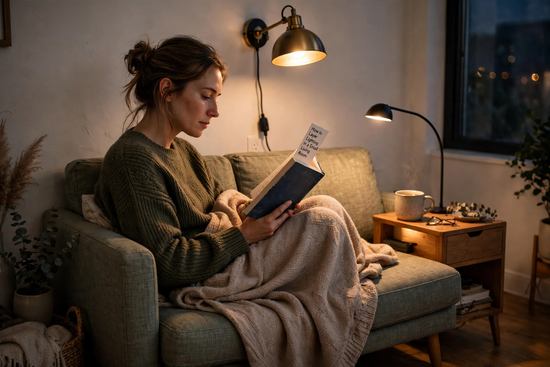
Task lighting works in tight rooms when it hangs on a wall or rides on furniture you already own.
5. Mount swing-arm sconces beside the sofa
Plug-in swing-arm sconces put reading light exactly where you sit. Set the shade’s lower edge near seated shoulder height, about 40 inches up, so the bulb stays out of your eyes.
6. Tuck an arc lamp behind the sofa.
A narrow-base arc lamp hides behind a sofa arm and arches over the seat. A downward shade keeps glare off the TV.
7. Choose a lamp that doubles as a side table.
One footprint holds your mug and lights your book, which is why lamp-table hybrids appear in so many modern living room ideas for small spaces.
8. Add under-shelf bars at a work nook.
Stick-on LED bars light a desk corner without another lamp. Match their Kelvin rating to the rest of the room so the nook blends in.
How Do Accent Lights and Controls Pull the Room Together?
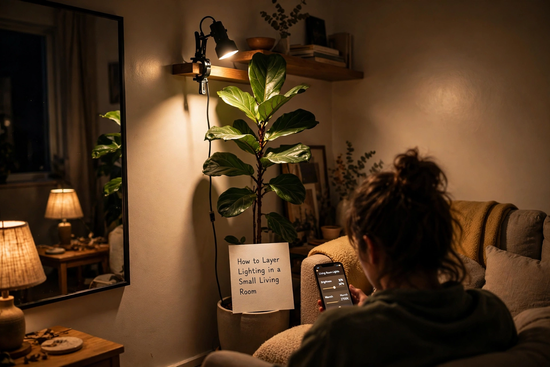
Accent lights and smart controls give a small room depth after dark. The contrast between bright and dim zones reads as dimension.
9. Spotlight one focal object.
A clip-on spot on a plant or framed print creates a destination, so the eye travels the room’s full depth.
10. Put every layer on a dimmer.
Plug-in dimmers shift one lamp from cleaning brightness to a low evening glow, provided the bulb box says dimmable.
11. Group lamps into smart scenes.
Smart bulbs bundle lamps into reading or movie scenes you trigger by phone or voice. The U.S. Department of Energy’s Energy Saver program reports that home LEDs cut energy use by 75% or more versus incandescent bulbs and stretch bulb life as much as 25-fold. So leave the accent scene glowing all evening; two 5-watt bulbs running five hours cost under a penny a night.
12. Reflect light with mirrors and satin paint.
A large mirror opposite a lamp doubles that lamp’s reach. Paint finish helps too. Satin walls reflect light back into the room, while flat paint absorbs more of it. That’s one of the more interesting facts about compact rooms: when walls sit this close, they become part of the lighting plan.
When the 20-lumen rule falls short
Dark rooms break the rule. Navy walls, wood paneling, and deep-toned floors absorb far more light, so push the budget toward 30 lumens per square foot and skip wall washing on the darkest wall, where grazing light exposes texture flaws instead of adding depth.
What Color Temperature and CRI Work Best in a Small Living Room?
Use 2700K bulbs for evening layers and 3000K for task lights, with a CRI of 90 or higher. In a small room every fixture shares one sightline, so mismatches show instantly.
A 4000K ceiling bulb beside a 2700K lamp turns one corner blue and the other orange. To avoid that clash, follow the color rules in interior design by DrHomey: pick one color temperature, such as 2700K, and use it in every fixture in the room. Dim-to-warm LEDs help in the evening by shifting warmer as they dim, with the exact range set by each bulb’s rating.
FAQ
What is the best lighting for a small living room?
The best setup combines a soft ceiling light or uplight, one reading light, and one or two accent lights. Keep every bulb at the same warm color temperature so the layers blend.
How many lights should a small living room have?
Most small living rooms need three to five light sources spread across at least three heights. A 150-square-foot room works well with one ceiling fixture, one reading lamp, and two accents.
Should a small living room have warm or cool light?
Warm white light between 2700K and 3000K suits most small living rooms. Bulbs above 4000K feel clinical at night and flatten the textures that create depth.
How do I make a small living room look bigger with lighting?
Aim light at the walls and ceiling rather than the floor. The eye reads brightened vertical surfaces as extra distance.
Can I layer lighting in a rental without hardwiring?
Yes, plug-in sconces, torchieres, LED tape, and smart bulbs build all three layers without touching the wiring. DrHomey recommends removable adhesive clips for cords and LED tape, so everything comes down cleanly when you move out.
Conclusion
Mastering how to layer lighting in a small living room turns a cramped box into a room with depth, because three modest layers beat one harsh fixture every time. Budget about 20 lumens per square foot, keep every bulb warm, and aim the light up and out.