
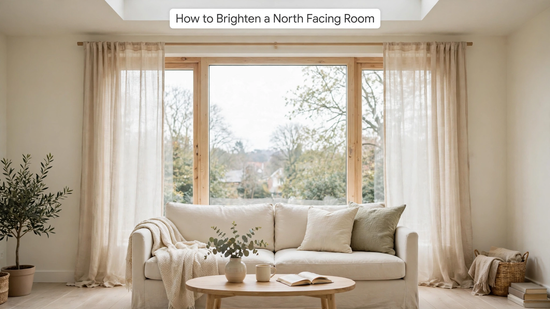
To learn how to brighten a north facing room, start with a warm-white paint that has a high light reflectance value, then layer 2700K–3000K LED lighting at three heights. Add mirrors beside the window, light floors and textiles, and slim window treatments so cool daylight bounces deeper into the space.
Key Takeaways
- North-facing rooms in the continental U.S. get indirect, bluish skylight all day and almost no direct sun.
- Warm whites with a light reflectance value (LRV) above 80 return the most daylight without turning gray.
- Bulbs rated 2700K to 3000K with a CRI of 90 or higher cancel the cool cast and keep colors true.
- A large mirror beside or across from a window works like a second light source.
- Cool grays and blue-based whites are the most common paint mistakes in north-facing spaces.
What Is a North-Facing Room?
A north-facing room is any room whose main windows face north, so in the U.S. it gets soft, indirect skylight instead of direct sun.
That light stays steady from breakfast to dinner, which is why painters have long liked north-lit studios. In a living space, though, it runs cool and dim.
Why Does a North-Facing Room Look Dark and Gray?
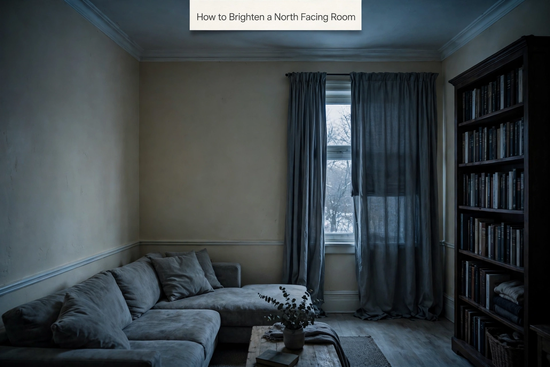
North rooms look gray because the sun moves across the southern sky over the continental U.S., so north windows only get reflected blue-leaning skylight. Almost no sunbeam ever reaches the floor — except for a brief sliver at sunrise and sunset in high summer.
That cool cast pulls the warmth out of every finish. Creamy beige goes oatmeal-gray, soft gray starts to look like concrete, and white trim picks up a faint blue edge. Winter makes it worse, because short days and a low sun leave only a few hours of strong daylight.
Where you live sets how bad it gets. A north room in Seattle or Minneapolis stays dim through most of December. The same room in Phoenix or Miami gets brighter reflected light bouncing off pale ground and sunlit walls nearby.
What’s outside the window counts as well. Deep roof overhangs, covered porches, dense hedges and a neighbor’s dark siding all cut the skylight that reaches the glass. When you plan exterior design changes, treat the north side of the house as a light source for the rooms behind it: lighter siding, trimmed foundation shrubs and pale paving all send more light indoors.
How to Brighten a North Facing Room: 12 Simple Ideas
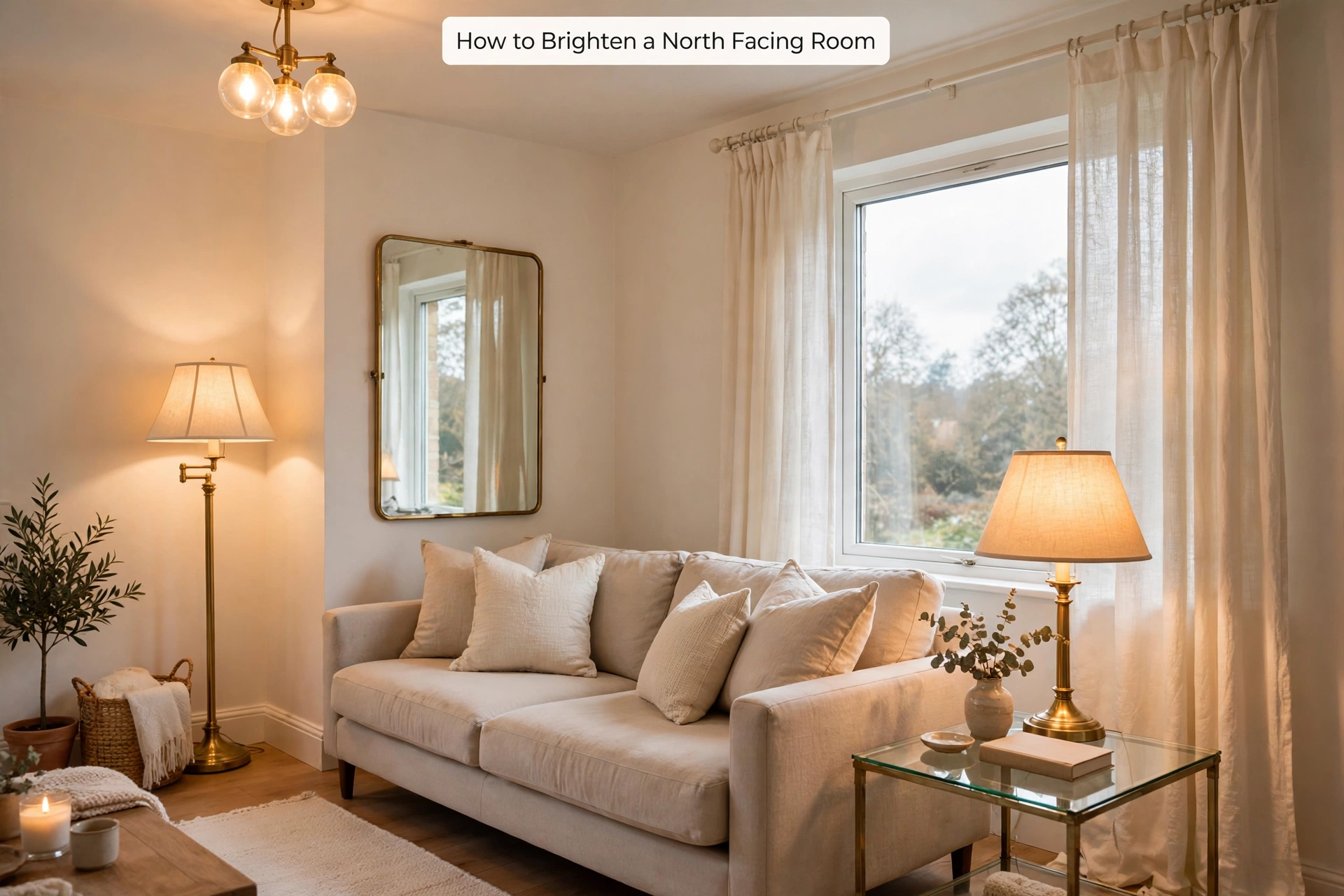
Paint, bulbs, and reflective surfaces make the biggest difference. Changes to windows, rugs and furniture finish the job. Ideas 1 through 7 cost the least and pay off fastest.
- Paint walls a warm white. Choose a cream- or yellow-based white with an LRV above 80, and avoid anything with blue or violet undertones.
- Use the ceiling as a reflector. Paint it flat white, one shade lighter than the walls, so overhead light spreads out instead of pooling.
- Choose a slightly shinier finish. Eggshell or satin walls bounce more light than flat paint, but they show patches, so sand any repairs smooth first.
- Hang a large mirror. Mount it on the wall next to the window or directly across from it. It catches skylight and sends it toward the darkest corner.
- Lighten the window treatments. Swap lined drapes for unlined linen sheers. Mount the rod 4 to 6 inches above the frame and extend it 8 to 12 inches past each side so the panels stack clear of the glass.
- Replace every bulb with a warm LED. ENERGY STAR says its certified LED bulbs cut energy use by up to 90% compared with traditional incandescents. At that rate, you can leave lamps on through a gloomy January afternoon without much effect on the bill.
- Light at three heights. Pair a ceiling fixture with table lamps at seated eye level and a floor lamp or wall sconce in each dark corner.
- Lay a pale rug. Wondering how big of a rug do I need? Pick one big enough that the front legs of every seat sit on it, with 8 to 18 inches of bare floor showing around the edges. Most living rooms end up with an 8×10 and larger open-plan spaces with a 9×12.
- Clean the glass and pull the screens. Grime and insect mesh noticeably dull the light coming in. Take the screens off the north windows you don’t open in winter.
- Add gloss and metal. Brass lamp bases, glass side tables, lacquered trays, and glazed ceramics scatter light around the room.
- Warm up the textiles. Pillows and throws in terracotta, ochre, rust, or blush offset the blue cast far better than gray or navy.
- Rearrange the furniture. Keep tall bookcases and armoires off the window wall. A low-back sofa under the window, with seats facing the glass, keeps the light path open.
Which Paint Colors Work Best in a North-Facing Room?
Warm whites and warm mid-tone neutrals work best, especially shades with yellow, red or peach undertones. Light reflectance value (LRV) measures how much light a color reflects on a 0–100 scale. The higher the number, the brighter the wall.
| Paint color | Code | LRV | Best use in a north room | Source |
| Pure White (Sherwin-Williams) | SW 7005 | 84.0 | Ceilings and walls in rooms with one small window | Samplize, Pure White SW 7005 sample page |
| White Dove (Benjamin Moore) | OC-17 | 83.16 | Walls and trim that need a soft white rather than a stark one | Benjamin Moore, White Dove OC-17 color page |
| Alabaster (Sherwin-Williams) | SW 7008 | 82.2 | Full-room walls, where its cream base resists the blue cast | Sherwin-Williams, SW 7008 Alabaster color page |
| Universal Khaki (Sherwin-Williams) | SW 6150 | 40.5 | Lower walls, cabinets or a single accent wall | Samplize, Universal Khaki SW 6150 sample page |
Pure White is the crispest of the three and can read blue in a very dim north room—if yours is, start with White Dove or Alabaster.
Sherwin-Williams picked Universal Khaki as its 2026 Color of the Year, announcing it in September 2025. Divide the khaki’s LRV by Alabaster’s, and you get about 0.49, so the trend color reflects roughly half as much light. If you want it in a north room, put it below a chair rail or on cabinets, and keep the upper walls and ceiling in a white rating above 80.
How Do Undertones Shift in North Light?
North light exaggerates cool undertones and tones down warm ones. That’s why a white that looks a little too yellow on the chip often looks just right on a north wall.
Greiges with a green base can drift toward olive drab. Pink-beige and peach-leaning neutrals hold up best, reading soft and flattering instead of flat. For sheen, use flat on ceilings, eggshell on walls, and semi-gloss on trim, so the glossy window casing outlines the light source.
The Most Common Mistake: Picking a Crisp Cool Gray
Cool gray fails in north light because people choose it under bright store lighting, and then it turns muddy blue on a wall that only gets skylight. This is the most common reason north rooms end up getting repainted.
The fix takes three days and two sample pots. Paint 12-by-12-inch swatches on two different walls, or use peel-and-stick samples. Check them at 9 a.m., 1 p.m., and 4 p.m. If a swatch reads blue, green or lavender, go one step warmer on the same paint strip. Of all the interior design tips for north light, this three-check test saves the most money.
How Much Light Does a North-Facing Room Need?
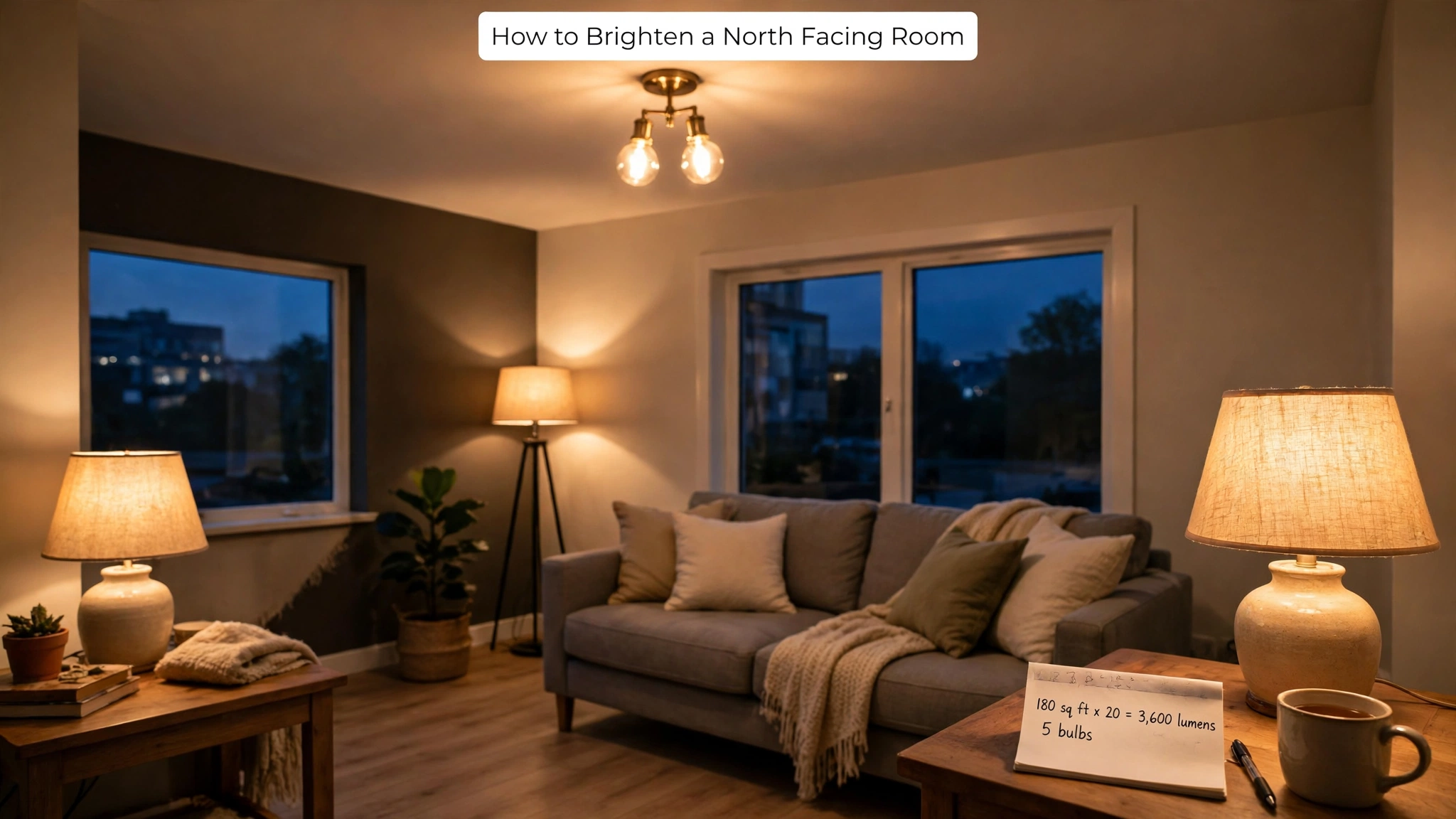
Aim for about 20 lumens per square foot in a north-facing living room, spread across at least three fixtures. Here’s how that works for a typical 12-by-15-foot room:
- Area: 12 × 15 = 180 square feet
- Lumens needed: 180 × 20 = 3,600 lumens
- Bulbs: 3,600 ÷ 800 lumens (one standard 60-watt-equivalent LED) = 4.5, so round up to five
- Layout: two bulbs in the ceiling fixture, one in a floor lamp and two in table lamps
The U.S. Department of Energy puts the savings from home LEDs at a minimum of 75% versus incandescent lighting. Five 60-watt incandescents draw 300 watts, so the LED set uses 75 watts at most, a saving of at least 225 watts while all five are on. Over a five-hour evening, that’s about 1.1 kWh saved per day.
The 75% figure is a minimum that covers home LEDs in general. The 90% figure in idea 6 applies only to certified bulbs, so buying certified widens the gap.
Bulb specs matter as much as bulb count. Keep every bulb at 2700K or 3000K, because one 5000K “daylight” bulb next to warm lamps makes north light look even bluer by contrast. Look for a CRI of 90 or higher so wood, skin tones and fabric look true. Put the ceiling fixture on a dimmer, too: bright on overcast mornings, low in the evening.
Lighting a Shaded North Entry
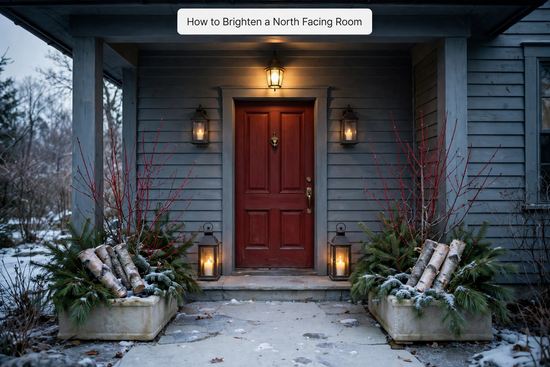
North-facing entries stay in shade from fall through early spring, so they need the same warm-light approach. If you’re working out how to decorate a front porch for winter on a north-facing house, start with a 2700K bulb in the porch fixture. Flank the door with lanterns holding LED candles. Fill the planters with evergreen boughs, birch logs and red-twig dogwood, which all keep their color without sun. A front door in a saturated color, such as deep red or ochre, stays readable even on the grayest afternoon.
Which Floors and Furniture Reflect the Most Light?
Light floors, pale upholstery, and pale woods reflect the most light, while dark stains and heavy fabrics absorb it. In a north room, every large surface either feeds the light or soaks it up.
Floors and Upholstery
White oak, maple, and ash floors with a satin finish bounce far more light than espresso-stained boards. If you rent or replacing the floor isn’t an option, cover dark boards with a large ivory or oat-colored rug. Upholstery in linen, cotton twill, or bouclé in cream or sand lifts the whole room. Washable slipcovers make light fabrics practical with kids and pets.
Mixing Wood Finishes
If you’re working out how to mix wood tones in a living room that faces north, let one light wood cover most of the surfaces and save darker woods for small accents. A simple split works well: about two-thirds light wood, then one medium tone, then one dark accent repeated at least twice. Match undertones (warm with warm, cool with cool), and put a rug between two woods that are close but don’t quite match so they don’t look like a failed attempt at a match.
How Do You Brighten a North-Facing Bathroom or Kitchen?
Use glossy, light-colored surfaces and add task lighting at face and counter level. Small north rooms with hard surfaces respond quickly to both.
In a kitchen, LED strips under the upper cabinets light the counters directly, and a glossy white or cream backsplash spreads that light across the room. In a bathroom, mount vertical sconces on both sides of the mirror at about eye level. This removes the face shadows that a single overhead fixture creates.
A cultured marble vanity top adds reflective shine for less than natural stone, but the disadvantages of cultured marble matter in a busy bathroom. The thin gel coat scratches and dulls with abrasive cleaners. Fine cracks, called crazing, form near the drain where hot water hits, light colors yellow over time, and deep chips are hard to repair invisibly. Where you need a tougher reflective surface, polished quartz or glazed ceramic tile gives you the shine without those trade-offs.
When Should You Skip Brightening a North-Facing Room?
Skip the brightening playbook when a small north room is used mostly at night, like a den, media room or guest bedroom. Under about 120 square feet with one small window, even a white rated above 80 usually looks dull gray by midafternoon. A deep, warm color such as olive, oxblood or chocolate brown makes the shadows look intentional instead. Paint the walls, trim and ceiling in the same dark shade, and rely on warm lamps rather than daylight.
FAQ
What color makes a north-facing room look bigger?
A warm white with an LRV above 80 makes a north-facing room look largest. Painting the trim and ceiling the same color softens the edges, so the eye reads the room as one continuous surface.
Should you paint a north-facing room white?
Yes, as long as the white has a warm, creamy undertone. Stark or blue-based whites turn gray under north light. Test any white on two walls before buying full gallons.
What bulb color temperature suits a north-facing room?
Bulbs rated 2700K to 3000K suit a north-facing room best. Their warm glow cancels the blue tint of indirect skylight, which matters most on overcast winter days.
Do mirrors actually brighten a north-facing room?
Yes, a mirror next to or across from a window makes a noticeable difference. Bigger glass bounces more light, and a floor mirror at least 5 feet tall works well in most living rooms.
Are north-facing rooms colder in winter?
North-facing rooms usually run colder because they get no direct solar heat. Insulated cellular shades closed at night and a thick rug over bare floors both help hold in warmth.
Is a north-facing room good for a home office?
Yes, a north-facing room makes an excellent home office because its light is even and glare-free. Screens stay readable all day, and you rarely need to close the blinds against direct sun.
Conclusion
How to brighten a north facing room comes down to three moves: warm whites rated above 80 LRV, 2700K to 3000K LEDs at three heights, and reflective surfaces that push skylight deeper into the room. Get those right, and a dim north room becomes the calmest, most evenly lit space in the house.