
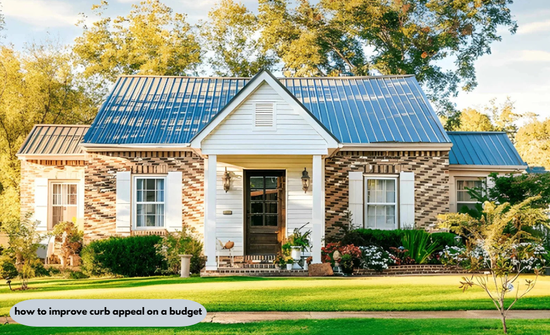
To learn how to improve curb appeal on a budget, start with free cleanup, then spend on the front door, lighting, and fresh mulch, in that order. A $300 weekend plan covering paint, hardware, plants, and edging changes how a home looks from the street without hiring a contractor.
Key Takeaways
- Cleaning, pruning, and edging cost only your time, and they deliver the biggest visible change for each hour you put in.
- The front door is the focal point of most homes, so paint and hardware there outperform spending spread thinly across the yard.
- A 2-cubic-foot bag of mulch covers 12 square feet at a depth of 2 inches, which makes bed costs easy to calculate before shopping.
- Small maintenance projects recover a larger share of their cost at resale than most full exterior replacements.
- Homeowners association rules, leases, and historic district codes override general advice on exterior colors and fixtures.
What is curb appeal?
Curb appeal is the overall impression a home’s exterior gives someone looking at it from the street, determined by its condition, color, landscaping, and entryway.
How to improve curb appeal on a budget in one weekend?
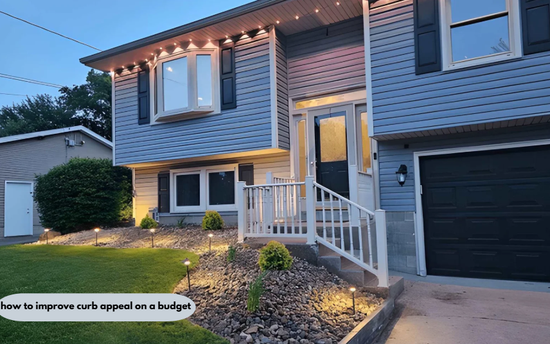
Work from free tasks to paid ones, and cap each purchase before you shop. The plan below totals exactly $300 and fits into two days.
- Clean everything first ($0). Wash the siding, sweep the walkway, clear the gutters, and wipe the windows. A garden hose and brush handle most dirt, and a borrowed pressure washer speeds up concrete and brick. Keep power washing on a low setting near siding and painted trim to avoid stripping the finish. Dirt conceals the real state of the paint, so cleaning also reveals what needs to be replaced
- Prune and edge ($0). Cut shrubs below window sills and slice a clean line between lawn and beds with a flat spade.
- Repaint the front door ($45). The power of paint is strongest here, because one quart covers a standard door with two coats and changes the whole entry. The cap includes a brush, roller, and tape. The same contrast rule drives home color schemes for small spaces: one strong accent against a quiet background.
- Replace house numbers and door hardware ($50). Match the finish on both so the entry reads as one design.
- Upgrade the exterior lighting ($60). Choose a porch fixture roughly one-quarter to one-third the height of the door. If the walkway is dark, divide the budget cap to include solar pathway lights, as they require no wiring.
- Mulch the front beds ($45). At roughly $4.50 apiece, ten bags fit within this cap.
- Add two planters ($60). Place potted plants on each side of the door, or group both on the hinge side of a narrow porch. Fill them with perennials suited to your climate zone so they return each year, which is the simplest form of low-maintenance landscaping. Planters are also the top most small apartment decorating ideas on a budget, because they move with you.
- Finish with porch decor ($40). Limit porch decor to a doormat and one accent, and use the remainder on spray paint to restore a faded metal mailbox in 20 minutes.
How much mulch does a front bed need?
Multiply the bed’s length by its width, then divide by 12 to get the number of 2-cubic-foot bags for a 2-inch layer. Ten bags will cover 120 square feet, which is enough for a bed 4 feet deep stretching 30 feet across the front of a house.
Measure before buying. A bed of 80 square feet needs seven bags, which frees about $13 from the cap for extra plants.
Among the interesting facts about mulch, depth matters more than brand, because a 2-inch layer blocks the light weed seeds need.
Which low-cost curb appeal upgrades pay back the most?
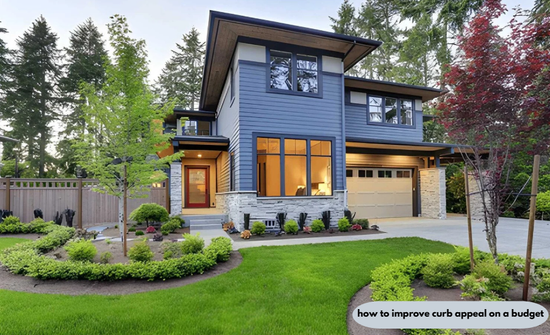
Routine lawn and landscape care returns more per dollar than any structural exterior project. A standard lawn care service costing $415 recovers 217% of its price at resale, according to the 2023 Remodeling Impact Report: Outdoor Features from the National Association of Realtors and the National Association of Landscape Professionals.
At that rate, the $415 comes back as roughly $900 in estimated value, a gain of about $485. Sellers should book fertilizer and weed control at least one full season before listing, because turf needs months to thicken.
Owners who plan to stay get the same visual benefit without a resale deadline. A green, edged lawn also makes every other inexpensive upgrade look intentional.
Fertilizer timing depends on grass type, so check comprehensive guides for your region before buying.
Is a new front door worth it, or is paint enough?
Paint is enough when the door is solid, seals tightly, and has no dents or rot. Replace the door only when it is damaged, drafty, or warped.
Good interior design starts at the threshold, so repeat the door color once inside the entry. Matching entry palettes are covered under interior design by drhomey.
According to the 2025 Remodeling Impact Report from the National Association of Realtors and the National Association of the Remodeling Industry, a new steel front door recoups 100% of its cost. A $45 repaint on a sound door therefore leaves more than $2,000 available for other work while still improving the same focal point.
The table shows how larger exterior replacements compare.
| Exterior project | Average job cost | Cost recouped at resale | Source |
| Garage door replacement | $4,672 | 268% | Zonda, 2025 Cost vs. Value Report |
| Steel entry door replacement | $2,435 | 216% | Zonda, 2025 Cost vs. Value Report |
| Fiber-cement siding replacement | About $21,400 (calculated) | 114% | Zonda, 2025 Cost vs. Value Report |
| Vinyl siding replacement | About $17,800 (calculated) | 97% | Zonda, 2025 Cost vs. Value Report |
The steel door percentage shown in the table exceeds the 100% figure above because the two studies measure different things. One pairs remodelers’ cost estimates with agents’ value estimates, and the other prices a specific contractor job in each market. Treat both as estimates, not guarantees.
The two siding costs are calculated by dividing each project’s reported resale value by its recouped percentage. Both sit far outside a budget plan, which is the practical reason to exhaust paint, cleaning, and landscaping first.
What curb appeal mistakes waste money?
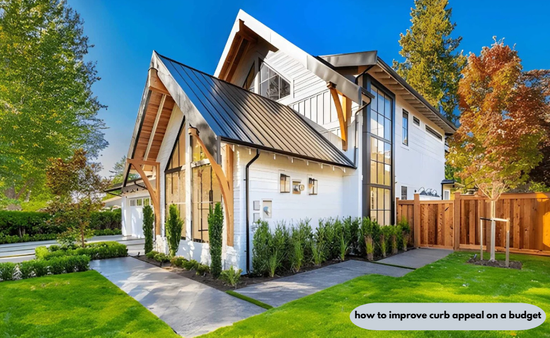
The costliest mistake is spreading a small budget across the whole yard instead of concentrating it at the entry. Ten scattered $30 purchases vanish when seen from the street, whereas $300 spent on the door and front beds can be seen from 50 feet away.
Americans spent an estimated $603 billion on home remodeling in 2024, according to the Harvard Joint Center for Housing Studies report. Improving America’s Housing 2025. Curb appeal does not belong in that category of spending. Treat it as maintenance, and set a fixed cap before entering a store.
Three other errors show up often:
- Buying plants before fixing beds. New flowers in weedy, unedged soil look neglected within two weeks. Edge and mulch first.
- Choosing a door color in the store. Paint chips shift under daylight. Tape the sample to the door and check it at noon and at dusk.
- Mixing metal finishes. Brass numbers, a black light, and a silver handle look accidental. Pick one finish and repeat it.
The focal-point rule also sits behind the best cozy living room ideas on a budget, where one rug or lamp carries the room. More handy tips by drhomey explain how to sample colors room by room.
The usual advice changes for homes with outside rules. Homeowners associations and historic districts often require approval for door colors, fixtures, and plantings, and renters should stick to removable items such as planters, doormats, and solar lighting.
Frequently Asked Questions
What is the cheapest way to improve curb appeal?
The least expensive approach is a complete exterior cleanup, which is free if you already have a hose, a broom, and pruners. Washing, sweeping, pruning, and edging remove the signs of neglect that buyers and guests notice first.
How much should I spend on curb appeal?
A budget of $300 covers the highest-impact upgrades for a typical front entry and bed. Spend more only when something is broken, such as a damaged door or a failed light fixture.
What color front door adds the most appeal?
The best door color contrasts clearly with the siding while matching the home’s fixed elements, such as roof and brick. Dark doors suit light siding, and saturated colors suit neutral gray, white, or tan exteriors.
How long do budget curb appeal upgrades take?
Most budget upgrades fit into one weekend, with cleaning and pruning on day one and painting and planting on day two. Door paint needs dry weather and several hours between coats.
Do curb appeal upgrades help a home sell?
Yes, a tidy exterior improves listing photos and first showings, which affects how many buyers schedule a visit. Lawn care needs the longest lead time, so start it a season ahead.
Conclusion
Knowing how to improve curb appeal on a budget comes down to sequence: clean first, fix second, and spend last at the front door. A fixed $300 cap, a tape measure, and one free weekend change a home’s first impression more than scattered purchases at any price.