

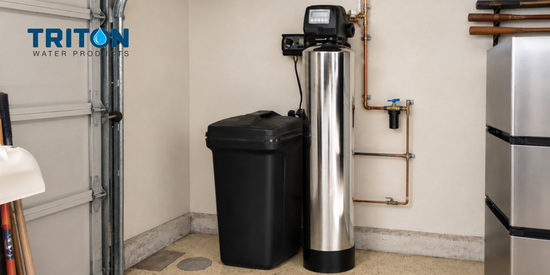
Hard water rarely announces itself with a plumbing emergency. Instead, it tends to leave smaller clues: cloudy glassware, chalky faucet deposits, stubborn shower-door film, reduced soap lather, and mineral buildup around water-using appliances.
Those signs are especially relevant in Brea. The City of Brea’s 2024 water-quality reporting listed total hardness at approximately 230 parts per million as calcium carbonate.
For households researching water softener installation in Brea, CA, that local data makes one point particularly important: treatment should begin with understanding what is actually in the home’s water.
Triton Water Products provides complimentary in-home water diagnostics for Southern California homeowners, allowing the appropriate treatment approach to be selected before equipment is installed.
Why Brea Homes Can Experience Hard-Water Problems
Water hardness primarily comes from naturally occurring calcium and magnesium dissolved in the water supply.
These minerals are not necessarily harmful to drink, but higher concentrations can contribute to scale deposits throughout a home.
Hard water can affect areas such as:
- Faucets and showerheads
- Water heaters
- Dishwashers
- Washing machines
- Plumbing fixtures
- Glass shower enclosures
Because household conditions can vary, professional water hardness testing provides more useful information than simply assuming every property requires the same system.
Over time, homeowners may begin exploring hard water treatment when routine cleaning is no longer enough to control mineral deposits.
What a Water Softener Actually Does
A traditional home water softener is designed primarily to reduce calcium and magnesium through a process called ion exchange.
This makes a water softener different from a standard filtration system. Softening specifically addresses hardness minerals responsible for scale, while filtration technologies are typically designed to reduce other substances in the water.
Before recommending a system, a professional installer may evaluate:
- Water hardness levels
- Household size
- Average water consumption
- Existing plumbing
- Available equipment space
- Drainage access
- Homeowner treatment goals
This evaluation helps ensure the equipment is properly sized instead of relying on a one-size-fits-all solution.
Water Softening, Conditioning, and Filtration Are Different
One of the most important considerations for homeowners is understanding that water treatment systems do not all perform the same function.
- A salt-free water conditioner or anti-scale system is generally intended to help manage scale without removing hardness minerals through traditional ion exchange.
- A whole-house water filtration system addresses different concerns. Depending on the filtration media used, these systems may help reduce substances such as chlorine, sediment, odors, and other targeted impurities.
An under-sink reverse osmosis system serves another purpose by providing highly filtered water primarily for drinking and cooking.
A household may therefore consider different solutions depending on its objectives:
- Traditional softening for reducing hardness minerals.
- Anti-scale treatment for managing mineral buildup.
- Whole-house filtration for broader water-quality concerns.
- Reverse osmosis for drinking and cooking water.
- Combined systems when multiple concerns are present.
Understanding these differences helps prevent homeowners from purchasing equipment that does not address their primary water problem.
Why Professional Installation Matters
Proper professional water treatment installation involves more than connecting equipment to the home’s incoming water line.
An experienced technician must consider several installation factors, including:
- Water pressure
- Plumbing diameter
- Equipment location
- Bypass valve placement
- Drainage requirements
- Electrical access when required
- Future maintenance accessibility
Correct system sizing is also important. Equipment that is too small may struggle to meet household demand, while unnecessarily oversized equipment may increase upfront costs without providing additional practical value.
Triton Water Products, led by owner Mark Harpenau, has served Southern California homeowners for 15 years.
The company provides professional installation, complimentary water diagnostics, annual maintenance, and ongoing service support.
For homeowners considering water softener installation in Brea, CA, professional evaluation can help determine whether traditional softening is actually the best solution or whether filtration, scale control, reverse osmosis, or a combination of technologies would better address the property’s needs.
A Better Starting Point for Brea Homeowners
Choosing the right Brea water softener or filtration system should begin with understanding the water rather than selecting equipment based solely on marketing claims.
Visible mineral scale may indicate a hardness issue, while concerns involving taste, chlorine, sediment, or drinking-water contaminants may require different treatment technologies.
A professional water assessment can help distinguish these concerns and identify the treatment method designed for each objective.
Triton Water Products offers complimentary in-home consultations throughout Brea and surrounding Southern California communities, helping homeowners compare practical treatment options before making an installation decision.
Frequently Asked Questions
1. What is the difference between a water softener and a whole-house water filter?
A water softener primarily reduces hardness minerals such as calcium and magnesium. A whole-house water filter targets substances based on the filtration media used, which may include chlorine, sediment, odors, and other selected impurities. Some homes use both because the systems address different water-quality concerns.
2. How much time should homeowners expect for a water softener installation?
In many homes, the installation can be finished in just a few hours. The exact duration can vary based on factors such as where the system will be placed, how easy the plumbing is to access, available drainage and power connections, and whether any pipe adjustments are needed before the unit can be installed.
3. Can water treatment help protect household appliances?
Reducing scale-forming hardness can help limit mineral deposits inside plumbing fixtures and water-using equipment. The degree of benefit depends on the home’s water hardness, water consumption, appliance design, and the type of treatment system installed.
