

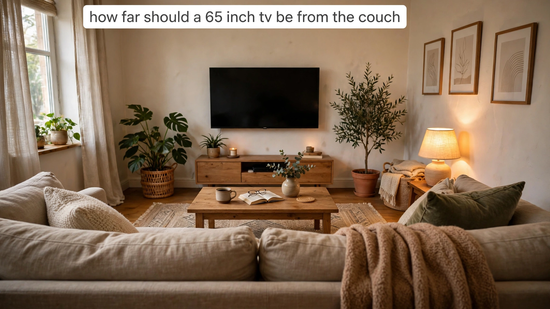
How far should a 65 inch TV be from the couch? Sit about 6.5 to 9 feet away, measured from your eyes to the screen, with roughly 8.8 feet suiting mixed shows and sports and 6.5 feet giving a theater-style picture for 4K movies.
Key Takeaways
- A 65-inch TV fills 30 degrees of your vision from about 8 feet 10 inches and 40 degrees from about 6 feet 6 inches.
- Measure from your eyes, not the front edge of the sofa, because a deep seat puts your head about 2 feet farther back.
- With 20/20 vision, you can see single pixels on a 65-inch 4K screen only from closer than about 4 feet 3 inches.
- The center of the screen should sit near seated eye level, usually 40 to 42 inches above the floor.
- If your seat is more than 10 feet from the screen, a 75-inch or 85-inch TV fits the room better than a 65-inch model.
What Is TV Viewing Distance?
TV viewing distance is the straight-line gap between a seated viewer’s eyes and the screen, and together with screen width it decides how much of your vision the picture fills.
How Far Should a 65 Inch TV Be From the Couch for Each Type of Viewing?
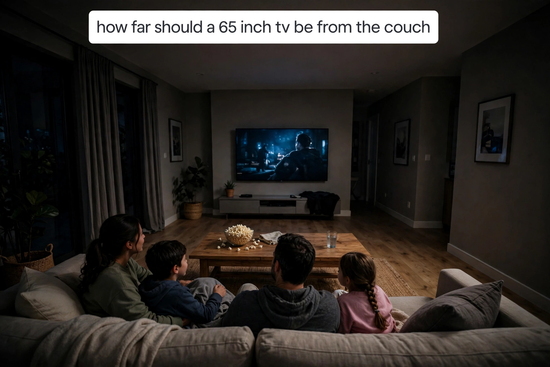
For everyday mixed viewing, aim for about 8 feet 10 inches. For movie nights, move closer, to between 6.5 and 7.25 feet.
A 65-inch 16:9 panel measures about 56.7 inches wide and 31.9 inches tall. Basic trigonometry turns that width into a seating distance for any viewing angle.
| Viewing goal | Screen fills | Eye-to-screen distance (65-inch) | Source for angle or basis |
| Background TV, news | 20° | 13 ft 5 in | Calculated reference point |
| Mixed use: shows, sports, streaming | 30° minimum | 8 ft 10 in | SMPTE guideline, as listed by RTINGS |
| Optimum home theater seat | 36° | 7 ft 3 in | THX guideline, as listed by Sound & Vision |
| Immersive cinema feel | About 40° | 6 ft 6 in | THX guideline, as listed by Kaleidescape |
| 1080p pixel limit, 20/20 vision | 1 arcminute per pixel | 8 ft 5 in | Calculated |
| 4K pixel limit, 20/20 vision | 1 arcminute per pixel | 4 ft 3 in | Calculated |
The middle rows boil down to two shortcuts that work for any 16:9 screen. Multiply the diagonal by 1.63 to get the mixed-use distance in inches, or by 1.2 to get the cinema distance.
In interior design, the TV usually acts as the room’s focal point, so the screen wall and the sofa line get fixed first. Rugs, lamps, and side tables come after.
Screens keep getting bigger. TVs 60 inches and larger made up 28.2% of global shipments in 2025, according to TrendForce. That figure covers worldwide shipments, not just U.S. sales, but it still shows that 65 inches has become a mid-size choice. Leave some slack in your layout for a bigger screen down the road.
How Do You Measure the Couch-to-TV Distance Correctly?
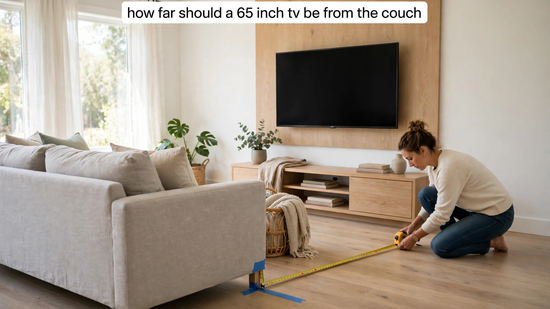
Measure from where your eyes sit when you’re seated to the front surface of the screen. That one change often moves the reading by about 2 feet.
- Sit the way you normally watch, then mark the floor directly below your eyes with painter’s tape.
- Find the screen’s surface. Flat wall mounts hold the panel 1 to 3 inches off the wall. On a stand, measure to the panel itself, not the console’s front edge.
- Run a tape measure along the floor between the two marks.
- Compare the number with the table. Under 6.5 feet feels intense; 6.5 to 9 feet is the target, and beyond 10 feet calls for a bigger screen.
- Tape a 57-by-32-inch rectangle on the wall and watch from the couch for ten minutes before you buy or drill.
A few measuring tips will save you a return trip. Measure every seat in a sectional, not just the middle one, because the corner seat often sits 1 to 2 feet farther away on the diagonal. Keep the tape flat on the floor, since a sagging tape adds inches to the reading.
Common Mistake: Measuring From the Front Edge of the Couch
Most people hook the tape on the seat cushion because it’s the easiest spot to reach. A typical sofa is 36 to 40 inches deep, though, and your head rests near the back cushion. Measuring from the cushion edge makes the screen seem closer than it really is, so buyers pick a TV that’s too small. The fix is to measure from your eyes every time.
Worked Example: A 14-Foot Living Room
Picture a room 168 inches deep. The sofa sits against the back wall, which puts the viewer’s eyes 30 inches out from that wall, and the TV hangs on a flat mount 3 inches off the opposite wall.
The real distance is 168 − 30 − 3 = 135 inches, or 11 feet 3 inches. From there, a 65-inch screen fills only about 24 degrees of your vision, which falls short of the mixed-use target. You have three fixes:
- Pull the sofa forward 24 inches. That brings you to 111 inches and about 29 degrees, with no new purchase.
- Choose a 75-inch TV, which fills about 27 degrees from the original spot.
- Choose an 85-inch TV, which reaches about 31 degrees and clears the target.
This decision sticks around. Circana put the average TV replacement cycle at about seven years in 2023 research, with replacement sets running roughly six inches larger than the installed average. Buy an undersized 65-inch set for an 11-foot seat now, and you’ll likely live with it until about 2033.
Does 4K Let You Sit Closer to a 65-Inch TV?
Yes. 4K lets you sit as close as about 4 feet 3 inches before the pixel grid shows, compared with about 8 feet 5 inches for 1080p.
Here’s why. Eyes with 20/20 vision can separate details about one arcminute apart, which is 1/60 of a degree. A 65-inch 4K pixel is about 0.015 inches wide, so it drops below that limit at roughly 51 inches away. A 1080p pixel is twice as wide, which doubles the distance.
That math leads to one of the more interesting facts about TV shopping. At the standard 8-foot-10-inch seat, your eyes can barely make out 1080p pixels, so 4K’s extra resolution adds little sharpness you can see from there. What makes a 4K set look better from that distance is HDR, wider color, and stronger contrast. If you sit 9 feet or farther back, put your budget toward peak brightness and contrast, not 8K.
How High Should You Mount a 65-Inch TV?
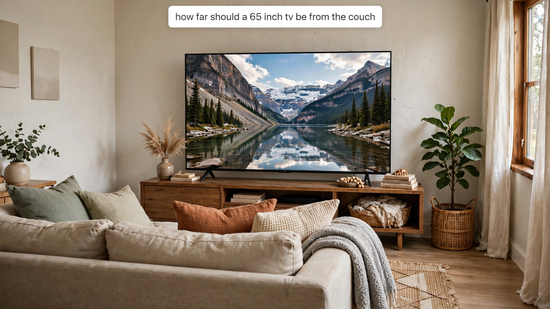
Put the center of the screen at or slightly above seated eye level, about 40 to 42 inches from the floor. With a 32-inch-tall panel, that places the bottom edge near 26 inches.
Height affects comfort as much as distance does. A fireplace mount with the screen’s center at 65 inches makes you look up about 13 degrees to reach the middle from 9 feet away and about 21 degrees to reach the top edge. If the mantel is your only option, a pull-down mount brings the screen back to eye level when you watch.
What If the TV Sits on a Console Instead?
For a 65-inch set on its own stand, pick a console about 20 to 24 inches tall. Most stands lift the panel 2 to 4 inches, which puts the screen’s center close to the 42-inch target.
The console should be at least 60 inches wide, and 70 inches looks more balanced under a 57-inch screen. Because it sits right below the picture, the console is the wood piece people notice most. If you’re figuring out how to mix wood tones in a living room, start with this piece. Either match the floor’s undertone (warm, cool, or neutral) or go at least two shades lighter or darker, then repeat that tone once elsewhere, such as a side table or picture frame.
How Does Room Light Affect Where the TV Goes?
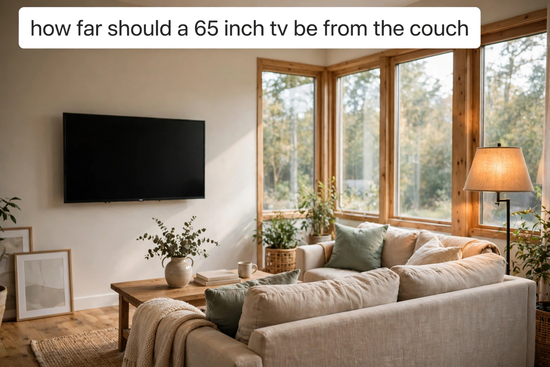
Put the screen on a wall at a right angle to your main windows. Facing a window causes reflections, and having a window behind the TV strains your eyes.
Rooms facing north get soft, even daylight with almost no direct sun, so glare is rarely the issue. The bigger problem is a dim room that makes the screen look harsh, which tempts people to turn brightness all the way up. If you’re learning how to brighten a north facing room, use 2700K to 3000K bulbs in floor lamps, and choose a light, warm-white paint for the wall behind the TV.
Add a bias-light strip to the back of the TV, and set it to 6500K; the same white point video is graded to. That light softens the contrast between a bright screen and a dark wall without tinting the picture. In rooms with bright south or west windows, a matte or anti-glare panel matters more than seating distance.
When Does the Standard Distance Not Apply?
Bedrooms break the standard numbers. You usually watch reclined across the foot of the bed from 5 to 7 feet away, where a 65-inch screen fills about 37 to 50 degrees of your vision, which is past cinema range. To work out how high to hang a TV in a bedroom, measure your eye height while you’re propped against the pillows, which usually lands 45 to 55 inches above the floor. Set the screen’s center at that height or a few inches higher, then add a 5-to-10-degree downward tilt so the panel faces your eyes straight on. Console gamers who need quick reactions and viewers with low vision also do well closer than the mixed-use row, often around 5.5 to 7 feet.
FAQ
Is 6 feet too close for a 65-inch TV?
No, 6 feet works well for 4K movies, though it feels intense for news or sports. From 72 inches, the screen fills about 43 degrees of your view. Low-bitrate cable feeds will show blocky compression from that close.
Is a 65-inch TV too small for a 10-foot viewing distance?
Yes, a 65-inch TV looks small from 10 feet. It fills only about 27 degrees of your vision there. A 75-inch model reaches about 30 degrees from the same seat.
How far should a 75-inch TV be from the couch?
A 75-inch TV works best from about 7.5 to 10 feet away. Its 65-inch-wide screen fills 30 degrees from 10 feet 2 inches and 40 degrees from about 7 feet 6 inches.
Should the TV be at eye level when you sit on the couch?
Yes, the center of the screen should sit at or just above seated eye level. For most sofas, that’s 40 to 42 inches from the floor. Low-slung modern sofas bring the ideal height down by a few inches.
How far to the side can you sit from a 65-inch TV?
OLED TVs hold their color and contrast for side seats much better than most LED models. VA-panel LED TVs lose contrast once you move past the edges of the screen. In a wide sectional, put the best seat dead center and angle the side seats inward.
Conclusion
How far should a 65 inch TV be from the couch? Plan on 6.5 to 9 feet from your eyes to the screen, with 8 feet 10 inches as the best all-around seat. Measure from where your head actually rests, put the screen’s center near eye level, and size up to 75 or 85 inches if your sofa lands past 10 feet.