
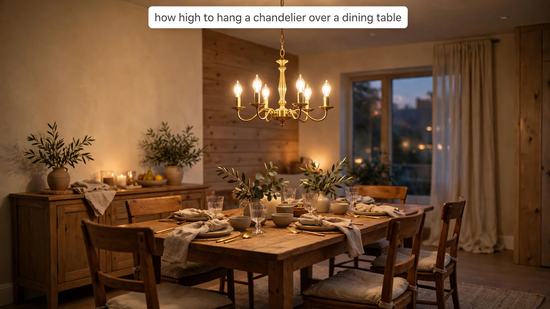
The answer to how high to hang a chandelier over a dining table is 30 to 36 inches, measured from the tabletop to the fixture’s lowest point, in a room with an 8-foot ceiling. Add roughly 3 inches of clearance for every foot of ceiling height above that, up to about 10 feet.
Key Takeaways
- The bottom of a dining chandelier belongs 30 to 36 inches above the tabletop under an 8-foot ceiling.
- Each extra foot of ceiling height adds about 3 inches to that clearance, up to about 10 feet.
- A fixture’s diameter works best at one-half to two-thirds of the table’s width and at least 12 inches narrower than the top.
- Always measure from the table surface to the fixture’s lowest point, never from the floor.
- To finish the job safely, use warm, dimmable LED bulbs and a ceiling box rated for the fixture’s weight.
What Is Chandelier Hanging Height?
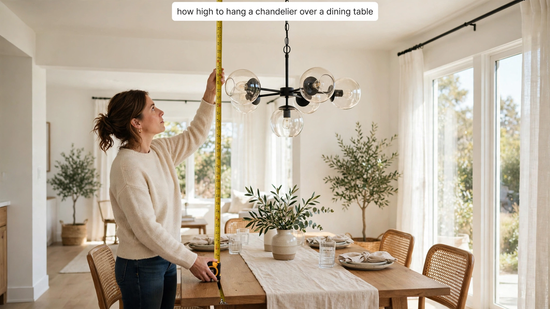
Chandelier hanging height is the open vertical gap between the surface of your dining table and the lowest part of the light fixture above it.
Chain length tells you almost nothing on its own. A 14-inch drum shade and a 30-inch tiered crystal fixture on identical chains end up at very different heights.
How High to Hang a Chandelier Over a Dining Table?
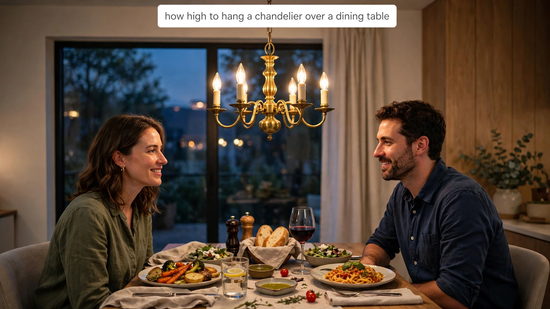
Under an 8-foot ceiling, set the fixture’s lowest point 30 to 36 inches above the tabletop. Lean toward 30 inches in a snug dining nook and toward 36 inches for wide tables or visually heavy fixtures.
The window balances two jobs. Seated guests need a clear view across the table, and the bulbs need to sit low enough to wash the plates with light rather than flood the whole room.
Mod Lighting’s March 2024 dining guide pairs that window with a 3-inch bump for every foot of ceiling above eight. Under a 10-foot ceiling, your target becomes 36 to 42 inches, so order the right chain or downrod length before the electrician arrives.
Style shifts where you land inside the range. Open-frame designs, such as wire cages, beaded rings and branching arms, let diners see through them, so they handle the 30-inch end well. Solid drums and opaque glass globes block more of the view and look better closer to 36 inches.
Table shape barely matters here, which surprises many homeowners. Of all the interesting facts about this rule, that one saves the most second-guessing: round, square, and rectangular tables share the same clearance, and only the fixture’s width and form change.
How Does Ceiling Height Change the Measurement?
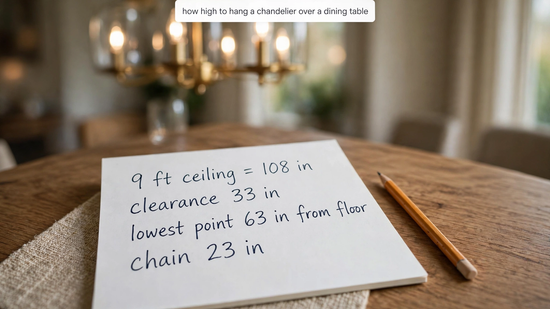
A taller ceiling raises the target, because a fixture hanging 30 inches over the table under a 10-foot ceiling looks cut loose from the room. The cleanest method works upward from the floor in inches.
Here is a worked example with a 9-foot ceiling, a 30-inch-tall table, and a fixture whose body measures 22 inches top to bottom:
- Convert the ceiling to inches: 9 × 12 = 108 inches.
- Set the clearance. Start at 30 inches and add 3 for the extra foot, giving 33 inches above the tabletop.
- Add the table height: 30 + 33 = 63 inches. The fixture’s lowest point sits there, measured from the floor.
- Subtract from the ceiling: 108 − 63 = 45 inches of total drop.
- Subtract the fixture body: 45 − 22 = 23 inches of chain, rod and canopy.
Under an 8-foot ceiling, that same fixture gets only 14 inches of chain (96 − 60 − 22). Under 10 feet, the lowest point lands 66 inches off the floor, and the total drop stretches to 54 inches.
Your hardware decides how precisely you hit that number. Chains adjust link by link, so you can fine-tune after the fixture goes up. Downrods come in set lengths, so you need the exact figure from step 5 before ordering.
What if the ceiling is vaulted or sloped?
Use the ceiling height at the mounting point, not at the room’s peak. On a sloped ceiling, use a swivel canopy so the mount follows the ceiling angle and the fixture still hangs straight down.
One of the most practical tips by DrHomey applies here. Stop adding the 3-inch adjustment at around 10 feet and let the table set the final position, because a fixture floating far above dinner throws glare instead of useful light.
What Size Chandelier Fits Your Dining Table?
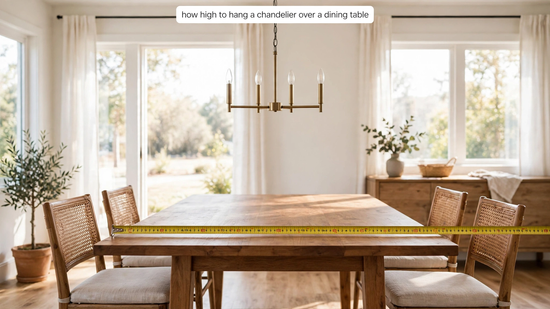
Pick a fixture between one-half and two-thirds of the table’s width, and keep it at least 12 inches narrower than the tabletop. That leaves about 6 inches per side, so nobody clips it when standing up.
| Sizing rule | Recommended figure | Source |
| Diameter vs. table width | ½ to ⅔ of the table’s width | Mod Lighting, How to Find the Right Chandelier Size for Your Dining Room |
| Maximum fixture width | 12 inches narrower than the table | Wayfair, Chandelier Size and Placement Guide |
| Clearance with ceilings above 8 ft | 36 to 40 inches | Postmodern Lighting |
| Diameter when no table is chosen yet | Room length and width in feet, read as inches | Lighting & Bulbs Unlimited, How to Size a Chandelier |
| Two fixtures over a 72-inch table | 24 inches wide each, hung 24 inches from each end | Postmodern Lighting |
The flat 36-to-40-inch figure for any tall ceiling runs higher than the stepped method. For a 9-foot room, the 3-inch-per-foot approach lands at 33 to 39 inches instead.
Delmar Fans stretches the upper limit to three-quarters of the table’s width. On a 48-inch table, that allows 36 inches, compared with 32 inches under the two-thirds rule and a 36-inch cap from the minus-12 rule. Stick with the smallest of the three when chairs tuck in tight, and save the largest for airy fixtures such as wire globes.
Length matters as much as width on rectangular tables. A common interior design approach sizes a linear fixture at about half the table’s length, so a 96-inch table takes a fixture near 48 inches long and leaves 24 inches of open table at each end.
What Bulbs and Brightness Work Best Over a Dining Table?
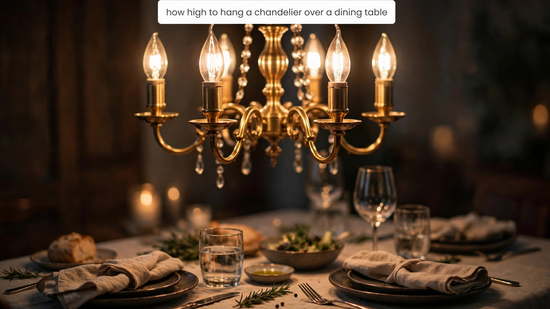
Choose warm LED bulbs on a dimmer, so the same fixture handles homework at 6 p.m. and a slow dinner at 9. The right bulb matters as much as the right height, because a perfectly placed fixture still glares when the bulbs are wrong.
Check these five points before you buy:
- Color temperature: Choose 2700K to 3000K for warm light that makes food look appetizing. Bulbs above 4000K give the table the feel of an office.
- Dimming: Buy bulbs labeled dimmable, and confirm the wall dimmer is rated for LED loads. A mismatch between the two is the usual cause of flicker and buzz.
- Color rendering: A rating of CRI 90 or above keeps sauces, greens, and skin tones looking natural, even when the lights are dimmed low.
- Bulb finish: Clear bulbs make crystal sparkle. Frosted or shaded bulbs cut glare when the fixture hangs near the 30-inch end of the range.
- Base type: Most chandeliers take small candelabra (E12) bases rather than standard household (E26) bases, so check the socket before ordering a full set.
According to the U.S. Department of Energy, residential LED bulbs cut energy use by at least 75% compared with incandescents, and their lifespan stretches up to 25 times further. As an example, take a six-arm chandelier with 40-watt candelabra bulbs. It draws 240 watts, and at 3 hours a night it uses roughly 263 kWh a year. LED replacements bring that to about 66 kWh or less, which saves close to 200 kWh annually from a single fixture.
How Do You Hang a Chandelier in an Open Floor Plan?
Center the fixture over the table, not over the room or the existing ceiling box. In an open layout, the chandelier marks where the dining zone begins and ends.
Settle the furniture first. Most open floor plan furniture arrangement ideas anchor each zone with one large object: a rug for the seating area and the table for dining. The light strengthens that second anchor only when it hangs squarely over it.
An off-center box has two fixes. A swag hook costs less and installs in minutes, while relocating the box gives a cleaner ceiling with no visible chain run.
If pendants hang over a nearby kitchen island, compare floor-to-bottom heights rather than clearances. Pendants 30 inches above a 36-inch counter end at 66 inches, and a dining fixture 33 inches above a 30-inch table ends at 63. A 3-inch gap reads as intentional, while a foot or more makes the two zones look mismatched.
What Mistakes Make a Dining Chandelier Look Wrong?
Measuring from the floor is the most common error. Installers often hang the fixture before the table arrives, guess at 5 feet and miss by several inches once a 29- or 31-inch table moves in.
The fix takes two minutes. Measure from the table surface to the fixture’s lowest point, whether that’s a crystal drop, a finial, or a shade rim. Then have a helper hold the fixture at the target while you sit in a dining chair. If you can’t see the face of the person across from you, raise it 2 inches and check again.
Weight trips people up too. Under NFPA 70, the National Electrical Code, a ceiling box serving a light must carry at least 50 pounds. Anything heavier needs a box listed for that load or support that doesn’t rely on the box. Check the shipping weight before you buy: a 65-pound crystal piece means a rated box or a joist-mounted brace, installed by a licensed electrician.
Buying by product photo causes the third problem, since listings rarely show a fixture next to a real table. Cut a cardboard circle at the fixture’s diameter, hang it from a string at your target height and look at it from the doorway before you order.
When does the usual rule not apply?
Low ceilings break the standard advice. Under a 7-foot ceiling, or where a dining corner doubles as a walkway, a fixture 30 inches over the table leaves too little headroom for anyone passing its edge. Choose a semi-flush mount, or shift the table directly beneath the fixture so no one walks under it. This matters most when you’re figuring out how to arrange furniture in a small living room that also holds a dining table, because that table tends to drift as the layout changes.
Frequently Asked Questions
Should a chandelier be centered on the table or the room?
Center the chandelier on the table, because the fixture lights the meal and defines the dining zone. If the ceiling box sits off-center, a swag kit or a relocated box solves it.
Can a chandelier be too big for a dining table?
Yes, a chandelier is too big once it’s wider than the table minus 12 inches. Oversized fixtures block sightlines, crowd the walls, and get bumped when diners stand up.
Does the 30-to-36-inch rule apply to round tables?
Yes, round, square, and rectangular tables all use the same clearance above the tabletop. Shape changes the fixture’s width and form, not its hanging height.
How high should a chandelier hang if family members are tall?
Raise the fixture 2 to 3 inches above your calculated target when several regular diners stand over 6 feet tall. Test from both a seated and a standing position, since people lean over the table to serve.
What bulb color works best in a dining room chandelier?
Warm white bulbs between 2700K and 3000K suit most dining rooms. Cooler bulbs above 4000K make food look flat and the room feel like an office.
Conclusion
Knowing how high to hang a chandelier over a dining table comes down to one number: 30 to 36 inches from tabletop to the fixture’s lowest point under an 8-foot ceiling, plus about 3 inches per extra foot, up to about 10 feet.Size the fixture to the table, center it over the table, and test the height from a seated chair before tightening the last link.