
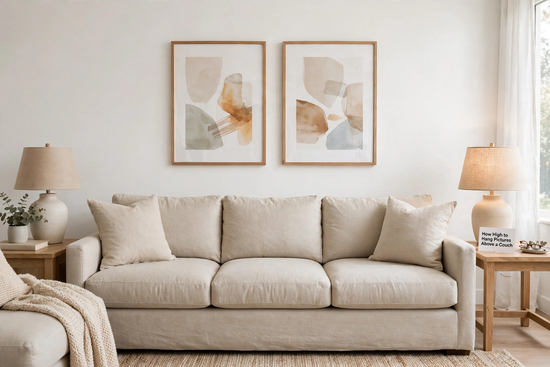
For how high to hang pictures above a couch, start with the sofa: size the art to about two-thirds of the sofa’s width, then leave a 6-to-10-inch gap above the back. Aim for a center near 57 to 60 inches from the floor—but when the gap and the center line disagree, trust the gap.
Key Takeaways
- The bottom edge of the art over a sofa belongs 6 to 10 inches above the highest point of the sofa back.
- Measure from the top of the sofa back, never from the seat.
- Art should span roughly two-thirds to three-quarters of the sofa’s width.
- Nail height equals the frame’s top edge minus the hanger drop.
- Reclining sofas need more clearance than the standard range provides.
What Is the 6–10 Inch Rule?
The 6–10 inch rule keeps the gap between a sofa’s top edge and the lower edge of the artwork above it between 6 and 10 inches. In interior design, that spacing makes the sofa and the art read as one composition.
Below 6 inches, heads bump the frame. Above 10, the piece drifts upward, and the sofa looks stranded.
How High to Hang Pictures Above a Couch: The Measuring Method
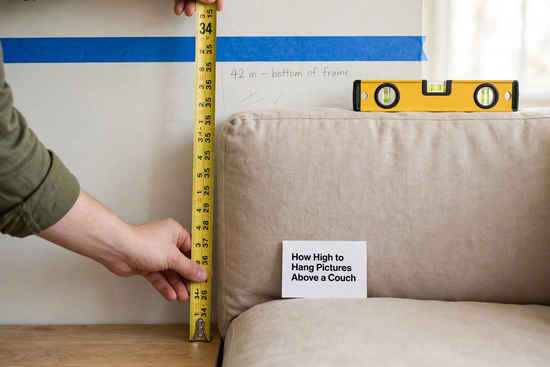
Start at the sofa, not the floor. The sofa back height plus your chosen gap gives you the line where the frame’s bottom edge sits.
- Measure the sofa back. Run a tape from the floor to the highest point of the back, including attached cushions.
- Choose a gap by ceiling height. Use 6 to 8 inches under a standard 8-foot ceiling. Under a taller ceiling, keep the gap and buy a taller piece instead of hanging higher.
- Mark the bottom line. Stretch painter’s tape across the wall at sofa height plus gap.
- Measure the hanger drop. Pull the wire taut with one finger and measure from that point to the frame’s top edge.
- Calculate the nail height. Add the frame’s height to your bottom line, then subtract the hanger drop to find where the nail goes.
Formula: Nail height = sofa back height + gap + frame height − hanger drop.
- Center on the sofa. Mark the sofa’s midpoint, not the wall’s.
- Match hardware to weight. Light frames hold on a picture hook in drywall. Pieces over about 25 pounds need a stud screw or a rated heavy-duty anchor.
A Worked Example With Real Measurements
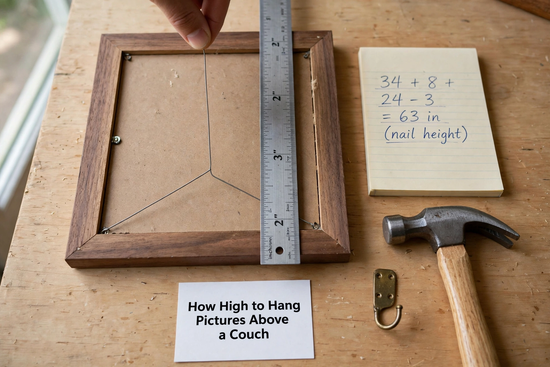
Your sofa back stands 34 inches tall, and you pick an 8-inch gap, so the frame’s bottom lands at 42 inches. The print is 24 inches tall, with a wire that pulls taut 3 inches below the top.
The top edge sits at 66 inches, so the nail goes in at 63. The center lands at 54 inches, below the 57-to-60-inch gallery convention, and that is correct: when furniture sits under the art, the sofa relationship outranks eye level.
Most comprehensive guides stop at the gap measurement. The hanger-drop subtraction is what saves you from a second nail hole.
How Wide Should Art Be Over a Sofa?
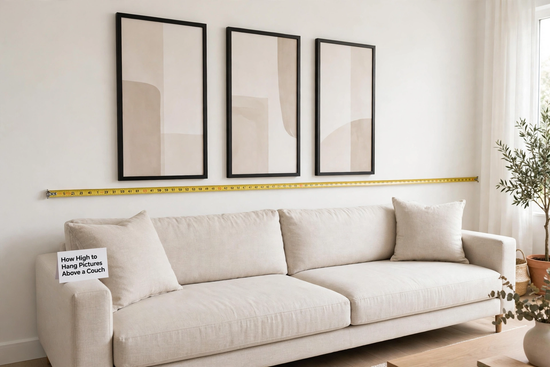
Aim for about two-thirds of the sofa’s width and never more than three-quarters. Narrower pieces look like postage stamps; wider ones crowd the lamps.
| Sofa width | Two-thirds target | Three-quarters maximum | Layout that hits the target |
| 78 in | 52 in | 58.5 in | One 52-inch canvas |
| 88 in | 59 in | 66 in | Two 28-inch frames, 3-inch gap |
| 94 in | 63 in | 70.5 in | Three 19-inch panels, 3-inch gaps |
| 102 in | 68 in | 76.5 in | Three 22-inch frames, 1-inch gaps |
Long, low sofas suit a horizontal piece or a row of frames. A compact loveseat often looks better under two vertical prints side by side.
The soundest advice on designing a sofa wall: settle the sofa first, buy the art second. A replacement sofa 4 inches taller can push a well-hung piece into head-bump range. All wall-decor tips by DrHomey begin with one habit: measure the furniture before choosing the frame.
What Mistakes Throw Off Art Above a Couch?
The most common error is hanging art at a fixed eye height without checking the sofa underneath. Three others follow close behind.
- The wire trap. When the frame lies face down, its wire sags—and if you measure from that sagging wire, you subtract too much, so the nail lands too low and the frame ends up hanging lower than you planned. Always pull the wire tight with one finger before you measure the drop.
- Chasing a tall ceiling. A 10-foot ceiling tempts people to hang higher. Keep the gap and buy a taller piece instead.
- Ignoring a recliner. When a recliner tilts back, the headrest swings toward the wall, and power headrests can also tilt forward and rise, so a frame 6 inches above the upright position can catch a head. Measure the headrest at its highest and most rearward position, add 10 to 12 inches, and pick an unframed canvas over glass. Wall-hugger recliners slide forward instead and usually fit the standard range.
How Does Art Placement Work in an Open Floor Plan?
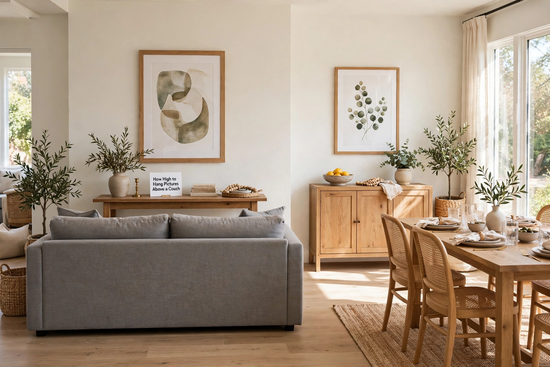
When a sofa floats with no wall behind it, the art moves to the nearest full wall above a console or credenza. You then measure the 6–10 inch gap from that furniture’s top.
In open layouts, one long wall often serves the living, dining, and kitchen zones at once. Among open floor plan furniture arrangement ideas, one works best for art: give each zone its own anchor piece, then keep every bottom edge at the same height so the space reads as connected.
Should Art Over a Bed or Near a TV Follow the Same Rule?
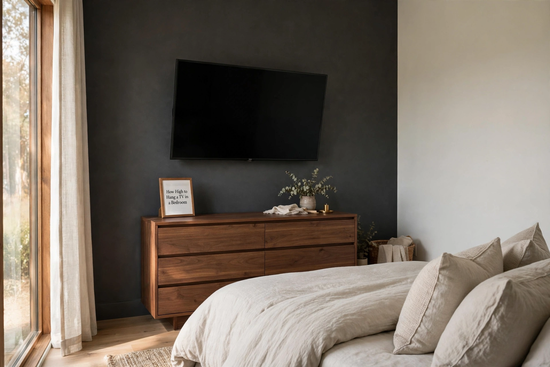
Art over a headboard follows the same 6–10 inch gap, measured from the top of the headboard. A TV is different: it follows your eye line, not the furniture.
Sit in bed as you normally watch and have someone mark the opposite wall at your eye level. That mark answers how high to hang a TV in a bedroom. If a dresser forces it higher, use a tilting mount angled down. If art shares that wall, line its bottom edge up with the bottom of the TV or its top edge with the top so the two read as one composition.
Americans aged 15 and over spent an average of 2.6 hours a day watching TV in 2024, according to the Bureau of Labor Statistics’ American Time Use Survey, so a screen hung too high adds up to real neck strain.
How Can Art Make a Living Room Feel Warmer in Winter?
A piece’s palette shifts how warm the room feels. Rust, ochre, and deep green read warm; icy blues read cool.
If you’re working out how to make a room feel cozy and warm for winter, the sofa wall is the easiest place to start. Swap a cool print for a warm-toned canvas at the same height, so you reuse the existing nail, and light it with a 2700K picture light or lamp. Warm art and amber light make a room set to the U.S. Department of Energy’s suggested 68°F while you’re awake feel more comfortable.
Frequently Asked Questions
Should art be centered over the couch or over the wall?
Center art over the couch, because the eye reads the sofa and artwork as one unit. Side tables and lamps then balance any leftover wall space.
What if my artwork is too small for my sofa?
Group it with other pieces or add a wide mat until the arrangement reaches about two-thirds of the sofa’s width. Flanking sconces also add visual width.
Can I hang art more than 10 inches above a sofa?
Only when something needs clearance, such as a reclining headrest or a window ledge. Otherwise, a larger gap disconnects the art from the sofa.
How far apart should frames be in a gallery wall over a sofa?
Keep 2 to 3 inches between frames so the whole group hangs as a single unit. Keep that spacing the same across rows and columns.
Does the 6–10 inch rule work for sectionals?
Yes, apply it to each wall separately, measuring from the section directly below. Put the main piece on the longer side of an L-shaped sectional.
Conclusion
Knowing how high to hang pictures above a couch comes down to one chain: sofa back, plus a 6-to-10-inch gap, plus frame height, minus hanger drop. Size the art to two-thirds of the sofa and center it on the furniture, and the wall looks planned rather than guessed.