

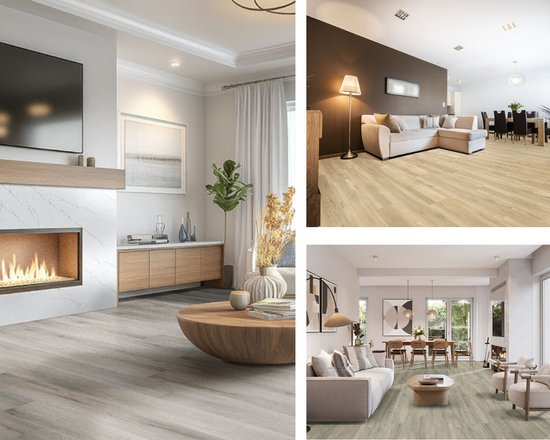
If you have been shopping for waterproof planks lately, you have probably noticed that “rigid core” is not one product. It is a family. Hybrid rigid core sits near the top of that family: a multi-layer waterproof plank built on a polymerized fortified composite core that is 100% PVC-free. The build favors dimensional stability, a bit more forgiveness over imperfect subfloors, and the wider, longer boards that look so good in open plans and commercial corridors. In short, it fills the gap between dense stone-composite cores and the softer acoustic feel of foamed-core construction. Browse MSI’s waterproof hybrid rigid core flooring lineup to see how those wide-plank formats show up in real rooms.
This guide walks through the four rigid core formats you will meet on a jobsite or at a showroom: hybrid rigid core, stone polymer composite (SPC), wood polymer composite (WPC), and glue-down vinyl. We will compare core construction, commercial specs, install methods, and where each format earns its keep. Rigid core luxury vinyl is a category, not a single SKU.
A Quick Look at the Four Formats
| Format | Core Material | Total Thickness | Install Method |
| Hybrid Rigid Core | Polymerized Fortified (PVC-free) | 10–12mm | Floating Click-Lock |
| Stone Plastic Composite | Stone Plastic Composite | 4–6mm | Floating Click-Lock |
| Wood Plastic Composite | Wood Plastic Composite (Foamed) | 5.5–8mm | Floating Click-Lock |
| Glue-Down Vinyl | Homogeneous/Heterogeneous PVC | 2–4mm | Full-Spread Adhesive |
One Rigid Core Family, Four Very Different Builds
All four formats chase the same basic goal: dimensional stability. How they get there is another story. Core density, thickness profile, and how the plank locks (or bonds) to the floor diverge more than a quick glance at a sample board suggests.
Builders and homeowners who already like waterproof vinyl sometimes treat these formats as interchangeable. That assumption gets expensive. Surface looks can match while wear layer depth, subfloor tolerance, and mid-plank stiffness do not. Specify the wrong core for the room, and you pay later in joint stress, telegraphing, or a floor that won’t take the load.
- Hybrid Rigid Core: reinforced composite core aimed at large plank formats and steady dimensional control
- Stone Polymer Composite: densest profile, thinnest cross-section, strongest dent resistance
- Wood Polymer Composite: foamed core that trades some stiffness for acoustic comfort underfoot
- Glue-Down Vinyl: adhesive-bonded, zero-float install for sustained-load and wet-zone work
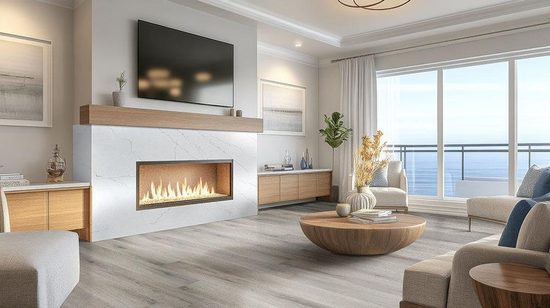
Avery Ash® Hybrid Rigid Core Flooring
What Sets Hybrid Rigid Core Apart?
How a plank handles force depends on the mix of minerals and polymers inside it. That mix decides how well the floor carries heavy loads, rides out temperature swings, and keeps long boards from waving mid-span. Understanding the construction layers before you write a spec saves a lot of callbacks.
Core Construction, Side by Side
- Stone Polymer Composite: Ground limestone powder and PVC, no foaming agent. Densest format and the slimmest profile at 4–6 mm. Least subfloor forgiveness; strongest resistance to structural dents.
- Wood Polymer Composite: Wood flour, PVC, and a chemical foaming agent. Softer core, thicker 5.5–8 mm profile, with built-in comfort and strong sound dampening.
- Hybrid Rigid Core: A PVC-free fortified composite that keeps larger planks stable, supporting boards up to 9″ wide and over 72″ long with less expansion and contraction risk.
- Glue-Down Vinyl: No floating click-lock at all. Thinnest format at 2–4 mm, permanently bonded to the subfloor.
Hybrid Rigid Core vs. SPC: Where Flex Matters
Put hybrid next to stone-composite construction, and the conversation usually lands on mid-plank flex. Hybrid rigid core is engineered for larger plank formats and tighter dimensional control. SPC tends to run thinner and denser. Most SPC vs. WPC debates stay inside those two materials. Hybrid adds a third path: a stronger composite that holds wide planks flatter under load, while a standard stone-composite core can flex a little more when weight sits mid-board.
Is hybrid “better” than wood-polymer composite? For larger commercial and whole-home jobs that need dimensional control over long spans, hybrid is often the safer pick. WPC still wins when acoustic comfort and a softer residential feel matter more, because a foamed core gives up some stiffness at wider widths. The best choice still depends on span, load, and which luxury vinyl trade-offs are most important for that project.
Wear Layer Specs and Commercial Ratings
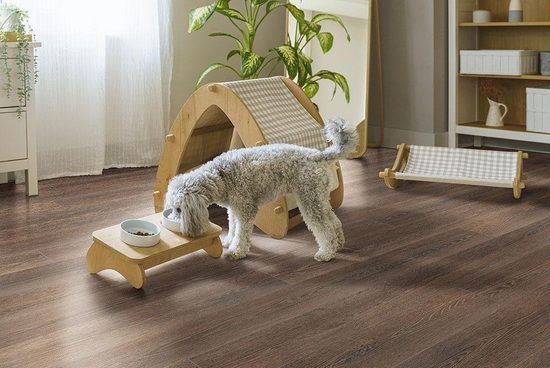
Hillsdale™ Hybrid Rigid Core
Before any commercial specification goes out, check the wear layer mil thickness. MSI’s CrystaLux™ Protection Layer starts at a 12 mil residential grade and can step up to a 30 mil commercial grade with CrystaLux Ultra™. Wear layer depth ties directly to warranty length and how the face holds up over years of traffic.
- 12 mil: Ideal for light residential and low-traffic spaces
- 20 mil: Aimed at light commercial spaces, multi-family hallways, and rental units
- 30 mil: Available from some manufacturers for healthcare clinics, education facilities, and heavy commercial footprints
Premium floating hybrid planks often arrive with factory-attached underlayment such as EVA, IXPE, or thicker acoustic foam on a waterproof backing. That usually means you do not need to buy a separate underlayment pad.
Full Comparison: Hybrid, SPC, WPC, and Glue-Down
Designers often skim past the details that matter once carts, chairs, and moisture enter the picture. The table below is the practical snapshot. When you weigh hybrid against traditional glue-down vinyl, remember that hybrid leans on core construction for stability and large-format support, while glue-down leans on adhesive bond and subfloor prep. For a broader SKU-level view across MSI’s vinyl lines, the EverLife comparison chart is a useful companion page.
| Feature | Hybrid Rigid Core | Stone Plastic Composite | Wood Plastic Composite | Glue-Down Vinyl |
| Core Material | Polymerized fortified (PVC-free) | Stone plastic composite | Wood plastic composite (foamed) | PVC, no composite core |
| Total Thickness | 10–12mm | 4–6mm | 5.5–8mm | 2–4mm |
| Wear Layer Options | 20 mil (AC4/AC5-rated) | 12–20 mil | 12–20 mil | 6–22 mil |
| Install Method | Floating click-lock | Floating click-lock | Floating click-lock | Full-spread adhesive |
| Subfloor Tolerance | 3/16″ in 10 ft. | 1/8″ in 6 ft | 3/16″ in 10 ft. | 1/8″ in 6 ft |
| Acoustic Performance | High (IXPE underlayment) | Moderate | High (foam core) | Moderate |
| Temperature Range | Climate-controlled (65–78°F); below-grade approved | Wide | Moderate | Narrow (adhesive-dependent) |
| Replaceability | Individual planks | Individual planks | Individual planks | Full adhesive removal required |
| Best Application | Commercial, whole-home, large-format | High-traffic, commercial | Residential comfort, multifamily | Healthcare, rolling loads, wet areas |
Which Format Fits Your Project?
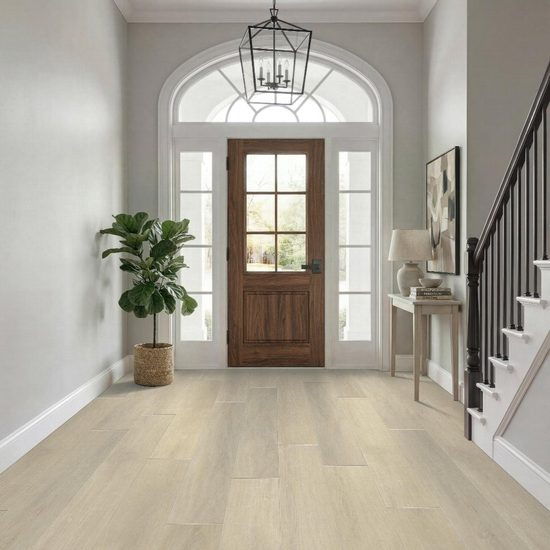
Wayne Parc™ Waldron Luxury Vinyl Planks
The “best” format is the one that matches traffic, subfloor condition, acoustics, and how permanent you want the install to be. Use the cues below as a starting filter for design teams and specifiers.
- High-traffic retail / showroom: Hybrid rigid core or stone-composite, with a 20 mil or higher wear layer and a high-density core that supports wide planks.
- Healthcare / senior living:A hybrid rigid core can reach the ANSI A326.3 wet DCOF rating of 0.42 or higher (verify each product’s score) while remaining stable under heavy loads.
- Hospitality / hotel corridors: Hybrid rigid core suits long corridors. Wide planks stretch the visual scale while meeting multi-story acoustic needs.
- Residential multifamily: Wood-polymer composite improves sound insulation and cuts noise transfer between stacked units.
- Wet areas (locker rooms, pool surrounds): Glue-down vinyl, where continuous adhesive backing limits moisture infiltration at seams.
- Renovation over existing hard surface: Hybrid rigid core or stone-composite floating profiles that clear door thresholds without full demolition.
- Radiant heat substrates: Stay within manufacturer temperature limits. The heating surface must remain at or below 85°F (29°C). Always check the product datasheet.
Floating Floor vs. Glue-Down: Which Install Wins?
Floating versus glue-down is less about fashion and more about loading and how you plan to renovate later. The operating environment usually decides.
Floating install uses tongue-and-groove click-lock joints. Planks lock together and rest above the subfloor with no glue. In a normal climate-controlled space, acclimation is typically not required; extreme heat or humidity still calls for at least 12 hours. Individual planks can be swapped out over the life of the floor.
Glue-down vinyl bonds every plank with full-spread adhesive so edges do not flex when heavy equipment rolls across. Remodeling later means serious scraper work. Specify glue-down when rolling loads, sustained moisture, or wide temperature swings are part of daily life.
When Glue-Down Beats Floating
Three conditions consistently favor adhesive bonding:
- Heavy rolling load environments: Continuous localized weight from hospital beds or supply carts can stress floating click-lock joints over time. Adhesive prevents that joint movement.
- Wide temperature fluctuation zones: Commercial garages or unconditioned storage areas benefit from adhesive systems that hold seam lines through expansion cycles.
- Constant high moisture below grade: Subfloors with ongoing vapor transmission need glue-down plus moisture vapor testing. Emissions greater than about 8 lbs per 1,000 sq ft per 24 hours (ASTM F1869) call for a moisture mitigation system before installation.
Specifying Hybrid Rigid Core for Commercial Work
A clean building spec matches product test data to local codes and accessibility rules. A few checkpoints help:
- DCOF compliance: For commercial wet areas, verify the product’s wet DCOF rating, commonly evaluated with ANSI A326.3. Confirm the slip-resistance standard for the project and local code. Check the MSI product data sheet; Hybrid Rigid Core planks with advanced registered embossing typically meet or exceed this traction benchmark.
- Wear layer rule: Require a minimum 20 mil layer for light commercial zones such as office suites and boutique retail. Scale up to a 28 mil minimum for high-occupancy civic spaces, including hospitals, schools, and transportation hubs.
- VOC compliance: For LEED points or healthcare air-quality mandates, specify products with FloorScore or CARB Phase 2 indoor air quality certifications.
- Shorecliffs™ HRC: For high-traffic commercial spaces that still need a premium look, specify MSI’s Shorecliffs™ HRC series. It delivers commercial-grade wear layers, large-scale wide planks, and a verified DCOF rating.
Subfloor Condition Decides What You Can Install
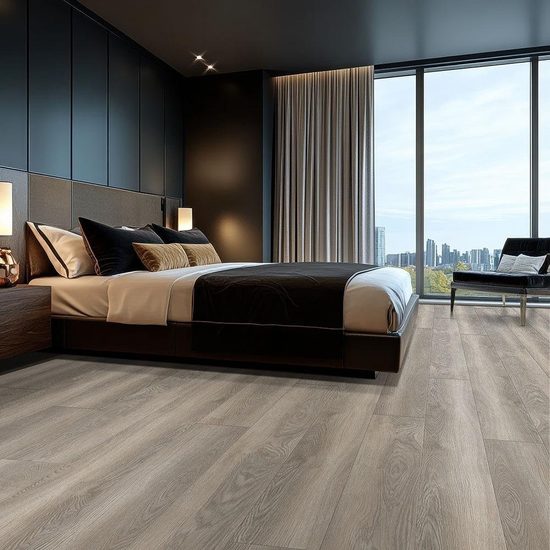
Wixom Valley Hybrid Rigid Core
The tolerance for vinyl plank subfloors is specific to each format. Skipping a flatness check before you buy is still one of the most common reasons joints fail, and mid-plank deflection shows up after installation.
No format is immune to an uneven substrate. The floor you walk on is only as good as what sits underneath it.
Subfloor Flatness Tolerances (Maximum Allowable Variation):
| Format | Maximum Variation | Span |
| Floating (Hybrid, Wood Composite) | 3/16″ | 10 ft |
| Stone Plastic Composite | 1/8″ | 6 ft |
| Glue-Down Vinyl | 1/8″ | 6 ft |
In practice, those numbers feel like this:
- Stone Polymer Composite: Maximum 1/8″ variation across any 6-foot run per MSI’s installation guide (tighter than general ASTM F710). Little flex over low spots; high spots become rigid pivot points that stress click-lock joints under traffic.
- Wood Polymer Composite: Up to 3/16″ in 10 feet. The thicker foamed profile bridges small low spots a bit better, but high spots remain a problem.
- Hybrid Rigid Core: Tight limit of 3/16″ over 10 feet. Wide-format planks cover longer distances, so one high spot can create noticeable mid-plank bend and stress on tongue-and-groove joints.
- Glue-Down Vinyl: Flatness within 1/8″ over a 6-foot span. Thin material bonds directly to concrete and telegraphs every substrate imperfection.
If the surface misses these targets, remediate with a self-leveling underlayment compound before any product goes down. Floating formats can bridge existing flat ceramic or porcelain tile when grout joint dips stay at or under 1/16 inch. Glue-down options need those joints leveled first; adhesive will not bond evenly in joint recesses.
Measure first. Remediate as needed. Product data sheets for each collection list the vinyl plank subfloor tolerance specs you will need before the specification is locked.
Ready to Choose the Right Rigid Core Format?
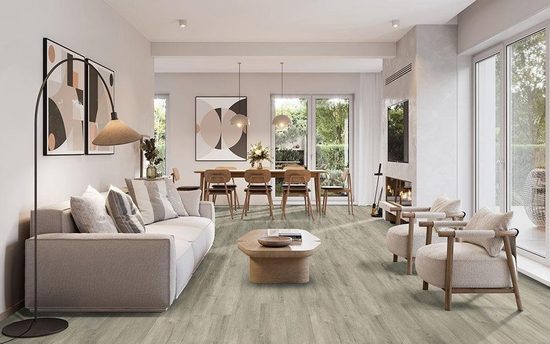
Glenridge Twilight Oak®
Quick Answers
What is hybrid flooring, and how is it different from standard luxury vinyl?
Hybrid rigid core flooring is a waterproof plank on a polymerized fortified composite core (100% PVC-free), built for large-format planks and demanding commercial environments. You get dimensional stability and, on many premium SKUs, factory-attached underlayment that standard luxury vinyl builds often do not include in the same way.
Is hybrid rigid core flooring the same as stone polymer composite?
No. Stone polymer composite uses a dense core of PVC and limestone. Hybrid rigid core uses a PVC-free fortified base designed for wider planks (up to 9 inches wide and longer than 72 inches), with stronger stability and often an integrated underlayment. The stone-composite format stays denser and thinner, optimized for more standard plank dimensions.
What is the difference between floating and glue-down vinyl flooring?
Floating systems click together without glue, and individual planks stay fully replaceable. Glue-down vinyl uses full-spread adhesive for zero joint movement under heavy rolling loads.
Which format is best for commercial projects?
Hybrid rigid core is a frequent commercial pick for large-footprint hospitality, healthcare, and high-end retail because of wide-plank formats and dimensional stability. Stone-composite shines in high-traffic commercial rooms. Wood composite fits residential multifamily when acoustic performance drives the decision.
How thick does the wear layer need to be for a commercial space?
Light commercial spaces typically need a minimum 20 mil depth. Heavy commercial environments such as hospitals, schools, and hospitality often call for 28 mil. Wear layer thickness shapes warranty term, scratch resistance, and long-term surface integrity.
Is hybrid rigid core flooring okay for wet areas?
Yes. All four formats are 100% plank-level waterproof. For sustained-wet commercial areas such as locker rooms or pool surrounds, glue-down vinyl is still the stronger choice because the adhesive bond helps keep moisture out of seam joints.
Will hybrid rigid core flooring work over radiant heat systems?
Yes, within manufacturer limits. Most hybrid rigid-core products allow radiant heat when the subfloor temperature stays at or below 85°F (29°C). Confirm the exact limit on the product data sheet before installation.
