

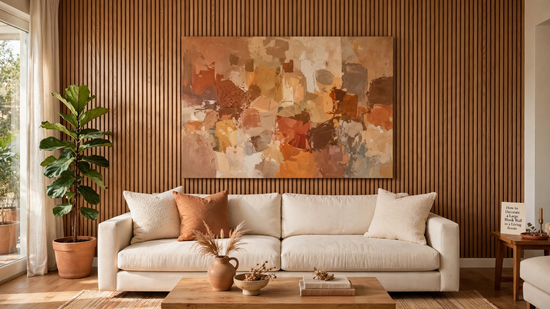
To learn how to decorate a large blank wall in a living room, pick one dominant treatment, such as oversized art, shelving, paneling, or color, and scale it to two-thirds of the furniture below it. Then hang it 8 to 10 inches above the sofa and add lighting.
Key Takeaways
- Art over a sofa should span about two-thirds to three-quarters of the sofa’s width.
- The bottom edge of a frame belongs 8 to 10 inches above the top of the sofa back.
- One bold treatment almost always looks better than many small objects spread across a big wall.
- A TV wall needs its seating distance planned before any shelves or art go up.
- Paint, wallpaper, paneling, and built-ins differ in cost by thousands of dollars, so measure square footage before choosing.
How to Decorate a Large Blank Wall in a Living Room?
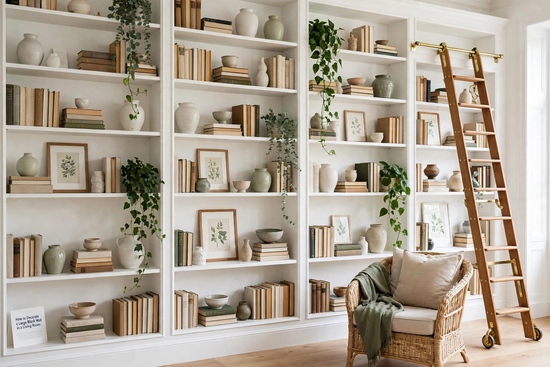
Choose one focal treatment that fills at least half of the wall’s width, then use lighter supporting pieces at the edges. Every option below works on a wall 12 feet wide or more, as long as you scale it correctly.
Standard DrHomey advice on designing a feature wall is simple: pick one hero, and make everything else support it.
- Oversized single artwork: A canvas 48 inches wide or larger fills space without visual clutter.
- Grid gallery wall: Six or nine identical frames in tight rows feel orderly, not busy.
- Floor-to-ceiling shelving: Freestanding units or built-ins turn the wall into storage and display at once.
- Accent paint or color drenching: A deep shade on one wall pulls the eye and makes the room feel finished.
- Wallpaper or a mural: Large-scale patterns suit large walls. Tiny prints turn into visual noise from across the room.
- Wall paneling: Board and batten, wood slats, or picture-frame molding add shadow lines and texture.
- Large mirror: A 60-inch floor mirror or a cluster of round mirrors bounces daylight deeper into the room.
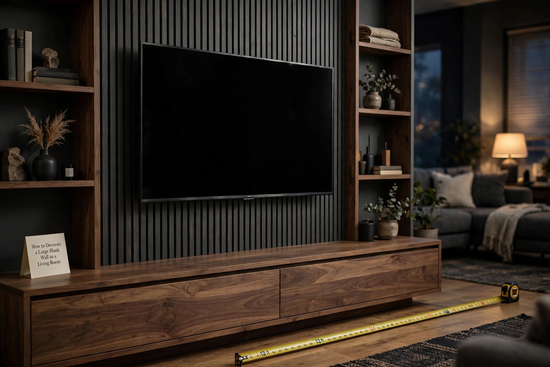
- Media wall: Frame the TV with cabinets, shelves, or paneling so the screen stops looking like a black hole.
- Textile hanging: A vintage rug, quilt, or woven tapestry softens echo in rooms with hard floors.
- Plants and ledges: A 6-foot fiddle-leaf fig beside a picture ledge fills both height and width.
- Layered lighting: Plug-in sconces or picture lights make the wall a focal point after dark.
How to pick the right idea for your wall
Match the idea to your wall’s size, your budget, and whether you own or rent. These decision rules narrow 11 choices down to two or three:
- Wall over 14 feet wide: Combine two ideas, such as paneling plus one oversized canvas, so the treatment reaches far enough.
- Ceilings 9 feet or higher: Go vertical with tall shelving, a floor mirror, or art stacked in two rows.
- Renting: Stick to leaning art, peel-and-stick wallpaper, freestanding shelves, and textiles.
- Wall faces the main entry: Choose color or wallpaper, since guests see it before anything else.
- Kids or pets in the house: Skip floor-leaning mirrors and glass shelves, and anchor every tall unit to studs.
How high should you hang art above a couch?
Hang art so its bottom edge sits 8 to 10 inches above the sofa back. On a bare wall with no furniture, center the piece about 57 inches from the floor, which matches average standing eye level.
Many people searching for how high to hang pictures above a couch skip the width rule. Height and width work together.
Worked example: an 84-inch sofa on a 16-foot wall
Two-thirds of 84 inches is 56 inches, and three-quarters is 63 inches. Your art, or your full gallery grouping, should measure between those two numbers.
Three 18-inch frames with 3-inch gaps total 60 inches. That fits.
If the sofa back stands 33 inches tall, the bottom of each frame lands between 41 and 43 inches from the floor. With 30-inch-tall frames, the center falls at 56 to 58 inches, right in line with the eye-level standard.
How to hang a gallery wall without extra holes
Plan the layout on the floor first, then move it to the wall in this order:
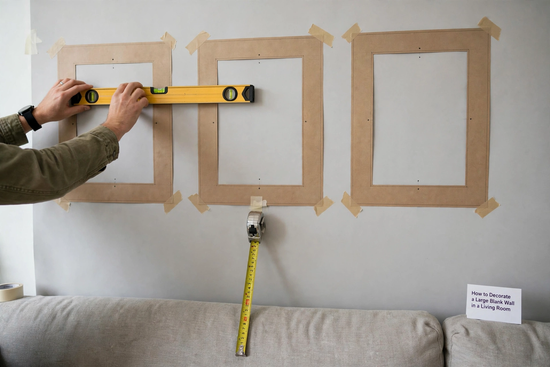
- Trace each frame onto kraft paper and cut out the shapes.
- Mark each cutout’s hanging point, measured from the top edge to the taut wire or D-ring.
- Tape the paper shapes to the wall, starting with the largest piece in the center.
- Check spacing with a level and a tape measure, keeping gaps between 2 and 3 inches.
- Drill through the marked hanging points, then tear the paper away.
For frames wider than 24 inches, use two hooks spaced apart instead of one. Two points of contact keep the piece level when someone bumps the sofa.
The most common mistake and its fix
Most people center art on the whole wall instead of on the furniture. The art then floats too high, and the sofa looks disconnected from it.
The fix takes painter’s tape. Outline each frame on the wall, live with it for two days, and adjust before you drill.
How far should a 65-inch TV be from the couch?
Place the couch about 8 to 13.5 feet from a 65-inch screen. Closer seats give a more cinematic view, and farther seats suit casual watching.
A common viewing-distance rule sets the comfortable range at 1.5 to 2.5 times the screen’s diagonal, which works out to 97.5 to 162.5 inches for this size. Measure from the screen to where your head rests, not to the front edge of the sofa.
Here is how that plays out. In a living room 15 feet deep, a sofa pushed against the back wall puts your head about 20 inches forward, or roughly 160 inches from a wall-mounted screen, so the setup stays inside the range with no rearranging.
Answering how far a 65-inch TV should be from the couch comes first, because the screen location decides where shelves and art can go. Mount the TV so its center sits near seated eye level, around 42 inches from the floor, and keep 6 to 12 inches of open wall around it before shelving begins.
How to style a TV wall so the screen blends in
Surround the screen with darker or textured materials so the black glass looks intentional. A charcoal paint color, wood slats, or a gallery of black-framed prints all reduce the contrast between the TV and the wall.
Hide cords with an in-wall power kit or a paintable cord channel. A low media console about 1.5 times the TV’s width visually grounds the screen and gives the wall a strong horizontal base.
How do you choose the right paint color for a big feature wall?
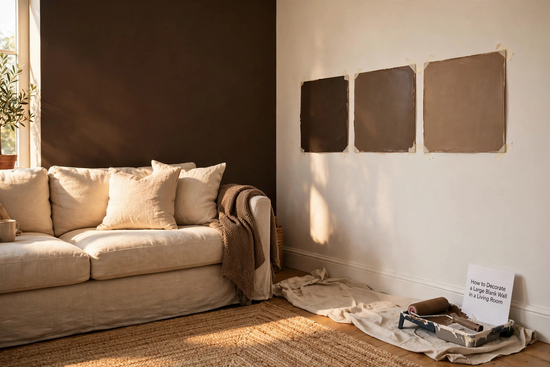
Start with the direction your windows face, then test large samples on the actual wall for at least two days. A color chip held in your hand tells you almost nothing about 150 square feet of wall.
Benjamin Moore named Silhouette AF-655, an espresso brown with charcoal undertones, as its 2026 Color of the Year in October 2025. A shade that dark absorbs light across a big surface, so plan for picture lights or sconces and keep the walls next to it a pale, warm neutral.
Knowing how to choose the right paint color for a wall this size comes down to three checks:
- North-facing rooms get cool, bluish light, so pick colors with warm undertones.
- South-facing rooms handle cooler grays and greens without feeling cold.
- Paint a 2-by-2-foot sample board and look at it at 9 a.m., 3 p.m., and 9 p.m.
Which paint sheen works best on a large wall?
Choose matte or eggshell for a large living room wall. Low-sheen finishes hide dents, patches, and uneven drywall that glossier paint exposes under side light.
Pull your accent color from something already in the room, such as a rug, a pillow, or the art you plan to hang. The wall then ties the room together instead of competing with it.
How do you make a large wall look finished at night?
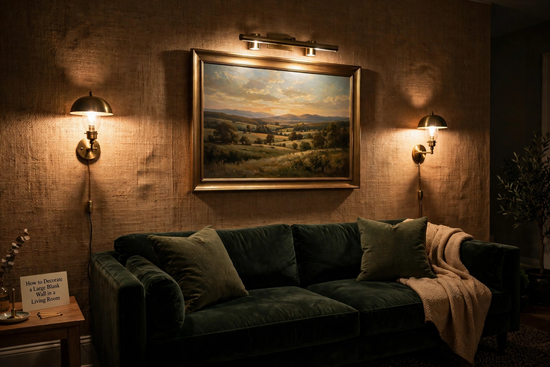
Add light at the wall itself, because ceiling fixtures wash big surfaces flat after dark. A wall that looks striking at noon often disappears at 8 p.m. without dedicated lighting.
Several practical tips by DrHomey cover this step:
- Mount sconces about 60 to 66 inches from the floor, spaced to frame the art or TV.
- Pick a picture light roughly half to two-thirds as wide as the frame it lights.
- Use warm bulbs in the 2700K to 3000K range so wood, brown, and green tones stay rich.
- Put sconces and picture lights on a dimmer or smart plug for evening control.
Texture works with light, too. Grasscloth, limewash, wood slats, and woven hangings all catch side light and create soft shadows that make a large wall feel layered instead of empty.
What does each large-wall idea cost?
Paint costs the least among permanent options, while paneling and built-ins cost the most. Measure your wall’s square footage before you request quotes.
Angi puts professional interior painting at $2 to $6 per square foot. For a wall 16 feet wide and 9 feet tall, that’s 144 square feet, so expect $288 to $864 for the paint work alone.
The project ranges in the table run higher because they track full jobs, which add prep, primer, repairs, and contractor minimums on top of the per-foot rate.
| Treatment | Typical installed cost | DIY difficulty | Best fit | Source |
| Accent wall paint | $718 to $1,840 per project | Easy | Fast, reversible color change | Angi, Cost to Paint an Accent Wall, 2026 |
| Wallpaper | $325 to $825 per project | Moderate | Pattern on a single wall | Angi, Cost to Install Wallpaper, 2026 |
| Wall paneling | $1,200 to $6,000 per project | Moderate to hard | Texture and architectural detail | Angi, Cost to Install Wall Paneling, 2026 |
| Built-in bookshelves | $1,399 to $4,888 per project | Hard | Storage plus display | HomeAdvisor, Built-In Bookshelves Cost, 2025 |
Compare the midpoints, and the gap becomes clear. A painted accent wall averages about $1,279 at the middle of its range, while paneling sits near $3,600, a difference of roughly $2,321 for the same wall.
Among budget-friendly interior design tips, the strongest is to spend where the eye lands first. Paint the wall yourself, then put the savings toward one large piece of art or a pair of quality sconces.
Oversized art, mirrors, textiles, and plants have no fixed install cost. Their price depends on the pieces you buy, which makes them the most flexible choices for tight budgets.
When does the usual big-wall advice not apply?
The two-thirds rule breaks down when your large wall sits in a small room or is broken up by windows and doorways. In a living room under 12 feet across, a floor-to-ceiling treatment on the long wall makes the space feel narrower, so think through how to arrange furniture in a small living room first. Float the sofa a few inches off the wall, use a low console in place of tall shelving, and hang art in a slim horizontal band. If windows split the wall, treat each section as its own small wall and repeat one frame size across all of them for rhythm.
Frequently Asked Questions
Should a large wall have one big piece or several small ones?
One big piece or a tight grid looks cleaner than scattered small frames. Small items spaced far apart read as clutter from across the room. If you love small art, group it into one rectangle with even gaps.
How much space should go between frames in a gallery wall?
Leave 2 to 3 inches between frames in most living rooms. Go up to 4 inches only when the frames are larger than 24 inches. Consistent spacing matters more than the exact number.
Can you decorate a large wall in a rental?
Yes, renters have plenty of damage-free options. Lean oversized art on a console, hang peel-and-stick wallpaper, or set freestanding shelves against the wall. Use removable strips only for frames under their stated weight limit.
What color works best on a large living room wall?
Mid-tone and deep warm colors work best because they give a big wall weight without glare. Bright white across a huge wall often feels flat and unfinished. Test the color at three times of day before committing.
Should the TV go on the largest wall?
Put the TV on the largest wall only if that wall faces the main seating and avoids window glare. Screens opposite windows pick up reflections all afternoon. If glare is a problem, give the big wall to art and move the TV to a side wall.
How do you fill a large wall on a budget?
Hang a large textile, add tall floor plants, or frame oversized prints from a print shop. A wide thrifted mirror or a single DIY slat panel also covers a lot of wall for little money. Spend on scale, not quantity.
Conclusion
Knowing how to decorate a large blank wall in a living room comes down to one bold focal point, scaled to two-thirds of the furniture below it. Measure first, hang art 8 to 10 inches above the sofa, and light the wall for evening use. Get those numbers right, and any of the 11 ideas will look intentional.
