
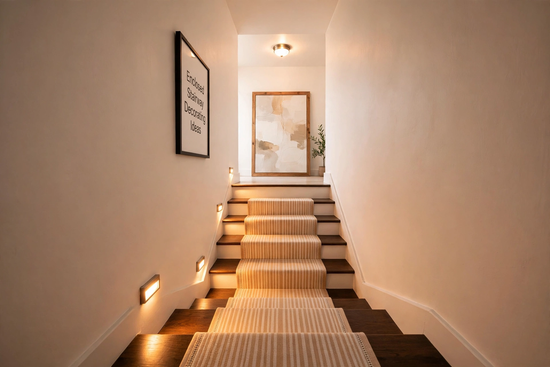
The best enclosed stairway decorating ideas pair light-reflecting paint with layered lighting, flat wall decor, and one bold focal point at the landing. Keep anything that projects off the walls shallow, hang art parallel to the stair slope, and spend first on light, because a dim tunnel always reads narrow.
Key Takeaways
- An enclosed stairway has walls on both sides, so light and color do more visual work there than railings or furniture.
- Art hung along a line parallel to the stair nosings looks straight from every step.
- Two coats on the side walls of a typical straight enclosed stair (about 264 sq ft) take about two gallons of paint.
- A runner for a 13-step straight stair needs roughly 20 feet of material once you allow for finishing the ends.
- Warm 2700K to 3000K bulbs and the brightest fixture at the top landing make a closed stair feel open and safe.
What Is an Enclosed Stairway?
An enclosed stairway is a staircase boxed in by full-height walls on both sides, with no open railing or balusters facing nearby rooms.
One of the more interesting facts about this layout is where it came from: many early American farmhouses hid their stairs behind a door so heat from the main-floor fireplace stayed downstairs. That history explains why so many older homes still have a narrow, closed stair today.
What Should You Measure Before Decorating an Enclosed Stairway?
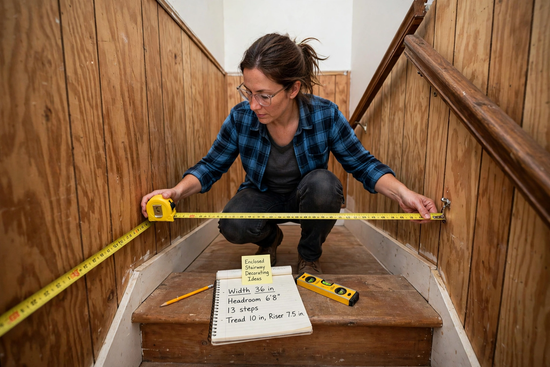
Measure clear width, headroom, wall area, and step dimensions before buying anything. Those four numbers decide which ideas physically fit.
Good interior design in a stairwell starts with a tape measure, not a mood board:
- Clear width at handrail height. Measure wall to rail, not wall to wall.
- Headroom. Measure straight up from the front edge of a tread to the lowest point overhead, including any light fixture.
- Wall length and average height. Multiply them for paint and wallpaper quantities.
- Tread depth, riser height, and step count. You need all three to order a runner.
The International Code Council’s 2024 International Residential Code requires at least 36 inches of clear stair width and 6 feet 8 inches of headroom. Apply that before ordering a light: a pendant with a 14-inch drop needs a ceiling at least 94 inches above the nosing line where it hangs. Any shelf or ledge also comes out of that 36 inches, so on a stair already at the minimum, stick to flat decor.
What Are the Best Enclosed Stairway Decorating Ideas?
The strongest ideas fall into five groups: color, light, walls, treads, and function. Pick two or three from different groups instead of stacking five from one.
Paint and Color Ideas
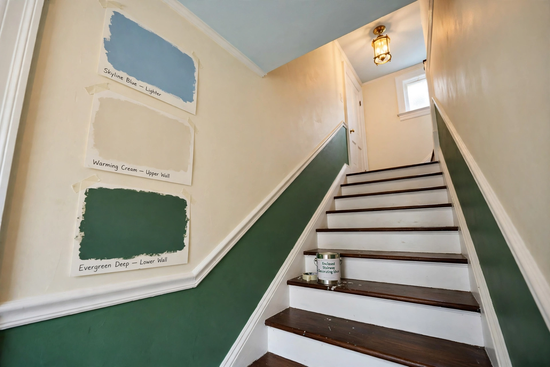
Paint changes a closed stair fastest, and the right direction depends on how much daylight reaches it.
- One pale shade everywhere. Matching walls, ceiling, and trim erase the edges that box a stairwell in.
- Dark on purpose. A deep wall turns a windowless stair cozy, provided the lighting is strong.
- Two-tone split. A darker lower third hides hand scuffs; a lighter top keeps the ceiling high.
- Painted risers. Contrast makes each step easier to see.
- Tinted ceiling. Pale sky blue overhead draws attention upward.
- Smart sheens. Use satin or eggshell on walls and semi-gloss on trim and risers, where shoes kick.
If you’re deciding how to choose the right paint color for a stairwell, test two-foot swatches at the bottom, middle, and top of the flight. Check them at night under your actual bulbs, since a closed stair spends most of its life under artificial light.
Benjamin Moore named Webster Green HC-130, a deep green, its 2027 Color of the Year in October 2026. In a stairwell, keep a shade that deep below a chair rail or on the risers unless a window or skylight feeds the space. For windowless stairs, choose wall colors with a light reflectance value (LRV) above 70.
Lighting Ideas
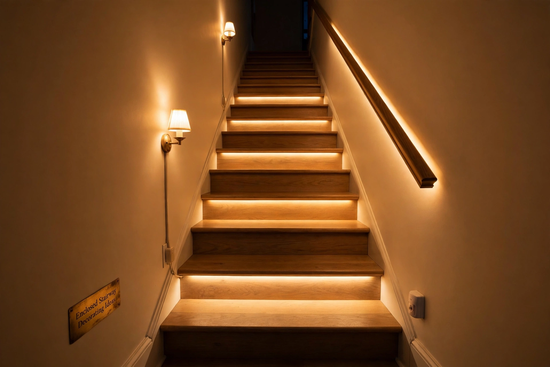
Lighting outranks every other choice here. Closed walls block the borrowed light that open stairs get from nearby rooms.
- LED step lights. Place one on every second or third step, about 12 inches above the tread.
- Under-rail LED strip. The handrail becomes a glowing guideline.
- Flush ceiling fixture. It lights the upper wall without eating headroom.
- Plug-in sconces. Paint the cord covers to match the wall.
- Motion sensors. They switch lights on hands-free, which also meets the top-and-bottom control rule shown in the cost table.
Choose bulbs rated 2700K to 3000K. Cooler 4000K light turns pale walls gray and makes a narrow space feel clinical.
Wall and Art Ideas
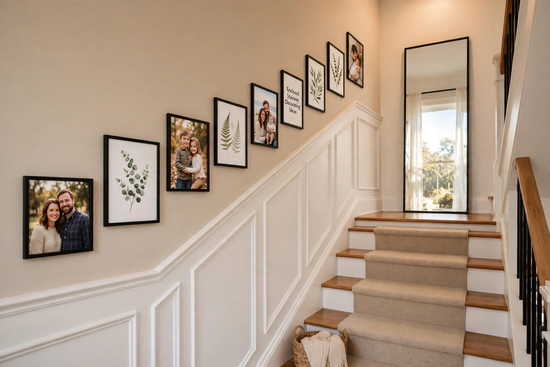
Wall decor should read well from the steps without poking into the walking path.
- Staggered gallery wall. Center each thin frame 57 to 60 inches above the tread below it, with 2 to 3 inches between frames.
- One oversized piece. A single large canvas at the landing looks deliberate.
- Vertical-stripe wallpaper. Stripes lift the ceiling and hide dents in old plaster.
- Board-and-batten molding. Trim adds depth while projecting less than an inch.
- Landing mirror. It doubles light and apparent depth at the turn.
- Diagonal mural. A painted band that follows the stair angle adds motion.
Tread and Floor Ideas
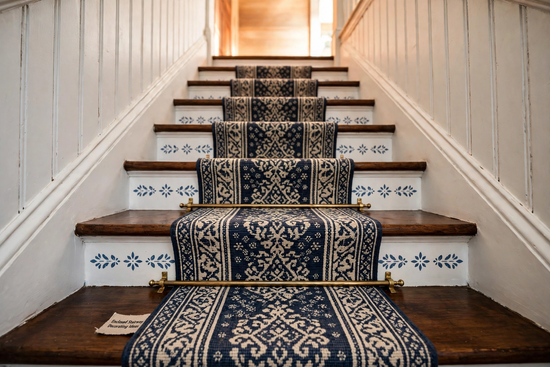
Every person on the stairs looks at the treads, so they deserve the same care as the walls.
- Stair runner. It quiets footsteps and adds grip and pattern.
- Stenciled or tiled risers. The flight becomes a feature from the bottom step.
- Contrasting stain. Dark treads over white risers stay crisp for decades.
- Clear anti-slip strips. Bare wood stays safe for socks and pets.
Runner math for a straight stair with 13 steps, 10-inch treads, and 7.5-inch risers: 13 × 17.5 inches = 227.5 inches, or about 19 feet. Order 20 feet to cover the top and bottom finishes. On a 36-inch stair, a 27- to 30-inch runner leaves 3 to 4.5 inches of wood showing on each side, which looks tailored.
Function and Storage Ideas
Function ideas earn a place only when the stair absorbs them without crowding.
- Drawer steps. The bottom treads hold shoes and leashes.
- Recessed niche. A cavity between studs displays a vase with zero projection.
- Slim handrail. A round rail on small brackets frees shoulder room.
- Landing bench or tall plant. The climb gets a destination.
How Do You Make a Narrow Staircase Look Bigger?
Remove visual breaks, raise the eye, and light the far end.
These are the same three moves behind how to make a small room look bigger, and on a stair they mean one continuous wall color, no clutter at handrail height, and a single vertical accent such as striped paper or a tall landing mirror.
How Much Does It Cost to Decorate an Enclosed Stairway?
A paint-and-lighting refresh costs well under $100 done yourself and several hundred dollars with a pro. Labor makes up nearly the entire gap.
Angi’s 2025 cost data puts the normal range for professionally painting stairway walls at $400 to $600. Here is the DIY math for a straight flight with two side walls, each about 12 feet long and 11 feet tall on average:
- Wall area: 12 × 11 × 2 = 264 square feet
- Two coats: 528 square feet of coverage
- Paint: about 1.4 gallons at 375 square feet per gallon, so buy 2
At the latex price in the table, two gallons cost $50 to $60. That frees $340 to $550 of a pro quote for a runner or step lights. Doing the labor yourself is the same trick behind most small apartment decorating ideas on a budget
| Item | Figure | Source |
| Handrail height | 34 to 38 inches above the nosings | International Code Council, 2024 International Residential Code |
| Handrail projection | Up to 4.5 inches into stair width | International Code Council, 2024 International Residential Code |
| Stair light controls | Switches at top and bottom for 6 or more risers, unless lights run automatically | International Code Council, 2024 IRC Study Companion |
| Latex paint | $25 to $30 per gallon | Angi |
| Painter labor | $40 to $60 per hour | Fixr |
| Primer and paint, staircase plus landing, 74.5 sq. ft. | About $700 | Fixr |
The staircase-and-landing row covers treads, risers, and rails, while the professional wall range above covers walls only. A full refresh of both lands near the sum.
What Mistakes Make an Enclosed Staircase Feel Smaller?
The most common mistake is decorating for someone standing on the floor instead of someone climbing a slope.
Frames in a level row. Hallway habits cause it. Snap a chalk line parallel to the nosings and hang from that.
Too many small ideas. Wallpaper, a gallery, and a mural together turn a stair into a tunnel of noise. Choose one hero idea and back it with two quiet ones, a rule that runs through all DrHomey advice on designing tight spaces.
A dark top landing. The stair starts to feel like a hole. Move the brightest fixture upstairs.
Cool-white bulbs. They flatten color and expose every wall flaw. Swap to warm white before repainting.
When Does Standard Stair Decor Advice Not Apply?
Steep basement stairs and old stairs narrower than modern code break the usual paint-and-art approach. Treat those walls as safety surfaces first. For those stairs, the most useful tips are simple: skip frames, mount a continuous graspable rail, add contrast strips on each nosing, and spend on tread lighting. Peel-and-stick wallpaper is the one wall upgrade that still fits, since it adds no depth.
Frequently Asked Questions
What color should I paint an enclosed stairway?
Paint a windowless enclosed stairway a light, warm neutral, and save deep shades for stairs you can light well. Aim for a paint with an LRV above 70 so the walls bounce light down the stair.
How do you decorate a stairway wall without clutter?
Pick one wall idea, either a single large piece or a tight gallery, and keep every frame in one finish. Matching frames read as a single shape.
What is the best lighting for a narrow staircase?
Recessed LED step lights paired with one shallow ceiling fixture give the most even light. Step lights handle the treads; the fixture fills the upper wall.
How high should you hang pictures on a staircase wall?
Center each picture 57 to 60 inches above the tread directly beneath it, following the stair slope. Take measurements from every tread individually, never the ground floor.
How wide should a stair runner be?
A stair runner should leave about 3 to 4.5 inches of tread visible on each side. For a typical 36-inch staircase, choose a runner between 27 and 30 inches across.
Can I decorate an enclosed stairway in a rental?
Yes, renters can use removable wallpaper, plug-in sconces, and a rod-held runner, all of which come out cleanly. DrHomey suggests photographing the walls first so the move-out matches the move-in.
Conclusion
Great enclosed stairway decorating ideas start with light, not objects. Paint the walls to bounce that light, keep every piece flat, and give the top landing a reason to look up. A narrow staircase becomes a passage worth climbing once color, lighting, and scale point the same direction.