

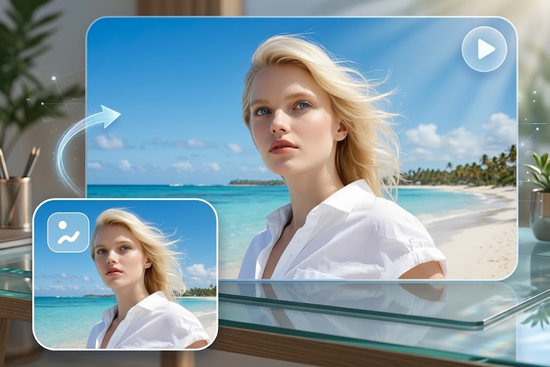
Turning a still image into an engaging video is one of the biggest advantages of AI-powered content creation in 2026. Modern image-to-video tools can add realistic movement, camera effects, facial animation, transitions, and even sound to static visuals, making them useful for social media, advertising, storytelling, product marketing, and short-form content.
But the tools are not identical. Some focus on cinematic motion, while others are better for social-media effects, talking characters, avatars, or complete AI production workflows. We compared the leading options based on output quality, ease of use, creative controls, pricing, speed, and overall value.
AI Image to Video Tools at a Glance
| Rank | Tool | Best For | Pricing | Main Strength |
| 1 | Magic Hour | All-in-one AI video creation | Free; Creator: $19/month or $12/month billed annually; Pro: $39/month or $25/month billed annually | Image-to-video, face swap, lip sync, templates, multiple AI models |
| 2 | Runway | Professional and cinematic video | Free tier; paid plans available | Advanced generation and creative controls |
| 3 | Kling AI | Realistic motion and cinematic clips | Free tier; paid plans from around $10/month | Strong motion and visual realism |
| 4 | Pika | Social media and creative effects | Free; paid plans from $10/month | Fast effects and image animation |
| 5 | Luma Dream Machine | Cinematic image animation | Free/paid tiers | Natural movement and visual quality |
| 6 | HeyGen | Avatars and talking images | Free; Creator $29/month; Pro $49/month | Talking avatars, voice, and localization |
Pricing can change as AI platforms introduce new models and plans. Magic Hour pricing above follows the requested current plan structure.
1. Magic Hour — Best Overall AI Image to Video Tool
Magic Hour stands out as an all-in-one platform for creators who want to turn images into videos while also having access to other AI-powered creation tools. It is particularly useful for creators searching for ai image to video capabilities alongside ai lip sync features in one workflow.
The platform combines image-to-video generation with face swap, lip sync, talking photos, AI image generation, video editing, upscaling, and other creative tools. Its biggest advantage is that users do not necessarily need to jump between different platforms for every stage of production.
Key Features
- Image-to-video generation
- Face swap for photos and videos
- AI lip sync
- Talking photos
- AI image generation and editing
- Video upscaling
- Click-to-create templates
- Multiple AI models in one platform
- Multi-step workflows such as generate → upscale → video
- Parallel generations for faster experimentation
- API access
- Desktop- and mobile-friendly workflows
- Commercial-use options on paid plans
Magic Hour also differentiates itself through its broad model selection. Instead of locking creators into one AI model, it provides access to multiple frontier models, making it easier to compare outputs and select the right approach for a particular project.
Another useful advantage is its workflow design. Creators can generate variations, make multiple takes, and move through several production steps without rebuilding the project in different applications. The platform also emphasizes regular feature releases and performance designed to handle larger production demands.
Pricing
Magic Hour offers:
- Free: A generous free option for testing and creating content.
- Creator: $19/month, or $12/month billed annually.
- Pro: $39/month, or $25/month billed annually.
One of Magic Hour’s notable value propositions is that credits do not expire. The platform also allows users to try its tools without necessarily requiring signup, making it convenient for creators who want to experiment before committing.
Drawbacks
Magic Hour includes a large number of tools, which can initially feel overwhelming to users who only need a simple image-to-video generator. Also, credit consumption varies by tool and generation type, so frequent users should monitor usage when producing many variations.
Best for: Creators, marketers, social-media teams, agencies, and anyone looking for an all-in-one AI content workflow.
2. Runway — Best for Professional Creative Control
Runway remains one of the strongest choices for creators who want more control over AI-generated video. Its tools are aimed at filmmakers, designers, marketers, and professional content teams that need sophisticated generation and editing capabilities.
Runway is particularly attractive when image-to-video generation needs to fit into a broader professional production workflow. It offers creative controls that can help users direct camera movement, style, composition, and other aspects of a scene.
Key Features
- Image-to-video generation
- Text-to-video
- Advanced video editing
- Generative effects
- Creative controls
- Professional production workflows
- AI-powered visual effects
Pricing
Runway offers a free tier with limited usage, while paid plans provide additional credits and capabilities. Paid access is generally more suitable for creators who generate content regularly.
Drawbacks
Runway can become expensive for heavy users because advanced generations consume credits. Its extensive feature set can also take some time to learn.
Best for: Filmmakers, professional editors, agencies, and creators who prioritize control.
3. Kling AI — Best for Realistic Motion
Kling AI is a strong choice when realistic movement is the priority. It has become particularly popular for generating cinematic clips with convincing human movement, camera motion, and environmental animation.
The platform can animate still images into short video sequences while preserving important visual characteristics of the source.
Key Features
- Image-to-video
- Text-to-video
- Cinematic motion
- Strong human movement
- Longer video generation options
- High-detail visual output
Pricing
Kling provides free usage in some form, while paid plans typically begin around the $10/month range depending on the current plan structure.
Drawbacks
Generation times can vary, and users may need several attempts to achieve the exact movement they want. Credit usage can also become significant when experimenting with multiple versions.
Best for: Cinematic scenes, realistic movement, characters, and visual storytelling.
4. Pika — Best for Social Media Effects
Pika focuses heavily on fast, entertaining AI video creation. It is especially useful for social-media creators who want to transform images using creative effects rather than produce conventional cinematic footage.
Its collection of effects and image-to-video features makes experimentation straightforward.
Key Features
- Image-to-video
- Creative AI effects
- Image transformations
- PikaScenes
- PikaSwaps
- PikaAdditions
- Short-form video creation
Pricing
Pika has a free plan. Its paid Standard plan currently starts at about $10/month, with higher tiers offering substantially more monthly credits.
Drawbacks
Pika is geared more toward short, creative clips than lengthy professional productions. Some effects can also produce inconsistent results depending on the source image.
Best for: TikTok, Instagram, memes, creative experiments, and short-form content.
5. Luma Dream Machine — Best for Cinematic Image Animation
Luma Dream Machine is another strong option for creators who want natural-looking movement and cinematic results. It can be particularly useful for animating photographs, product images, environments, and artistic compositions.
Its appeal comes from the way it handles motion and visual continuity, making it useful for mood-driven content and promotional videos.
Key Features
- Image-to-video
- Text-to-video
- Cinematic motion
- Creative image animation
- Multiple generation options
- High-quality visual output
Pricing
Luma offers free and paid options. Its Dream Machine pricing includes entry-level paid plans, with its web Lite plan listed at $9.99/month in its current payment documentation.
Drawbacks
Free usage is limited, and advanced generation can consume credits quickly. Users looking for extensive editing or avatar workflows may also need another application.
Best for: Cinematic visuals, product imagery, artistic projects, and atmospheric scenes.
6. HeyGen — Best for Talking Images and Avatars
HeyGen takes a different approach from traditional image-to-video generators. Rather than focusing primarily on cinematic animation, it specializes in AI avatars, talking characters, voice generation, translation, and business-oriented video production.
This makes it particularly useful when a static portrait needs to become a presenter, spokesperson, or multilingual digital character.
Key Features
- AI avatars
- Talking photos
- Voice cloning
- AI video generation
- Lip-sync translation
- Multilingual video
- Digital twins
- Video localization
Pricing
HeyGen has a Free plan, while Creator costs $29/month and Pro costs $49/month. The current plans include different credit allocations, video limits, and export capabilities.
Drawbacks
HeyGen is more specialized around avatar-driven content than pure cinematic image-to-video generation. Creators who want highly experimental visual motion may find dedicated generative-video platforms more suitable.
Best for: Presenters, educators, marketers, business videos, localization, and talking-avatar content.
How We Choose These Tools
We evaluated these AI image-to-video platforms according to several practical criteria:
Output Quality
The most important factor is whether the generated video looks natural. We considered motion quality, image preservation, consistency, facial details, and overall visual polish.
Ease of Use
A powerful model is less useful if creating a simple video requires a complicated workflow. We favored platforms that make the process accessible to beginners while still providing useful controls for experienced creators.
Features
We looked beyond basic image animation. Face animation, templates, editing, lip sync, avatars, upscaling, model variety, and workflow automation can make a significant difference.
Pricing and Value
AI video generation can become expensive when users generate many variations. We considered free access, entry-level plans, credit systems, and the amount of creative functionality available at each price point.
Speed and Workflow
Fast iteration matters for social-media creators and production teams. Tools that make it easy to generate multiple versions or move between creation stages receive additional consideration.
Use Cases
Finally, we considered who each tool is actually designed for—from casual social creators to professional filmmakers, marketers, and businesses.
Frequently Asked Questions
What is an AI image-to-video generator?
An AI image-to-video generator uses artificial intelligence to animate a still image and turn it into a video. Depending on the platform, users can control motion, camera movement, style, duration, and other visual elements.
Which is the best AI image-to-video tool in 2026?
For an all-around workflow, Magic Hour is our top pick because it combines image-to-video with face swap, lip sync, talking photos, templates, multiple AI models, and other creation tools.
Can AI animate a normal photograph?
Yes. Most modern image-to-video tools can animate photographs. Results are generally strongest when the source image is clear, high-resolution, and contains a well-defined subject.
Is there a free AI image-to-video tool?
Yes. Several platforms offer free tiers, including Magic Hour, Runway, Pika, Luma, Kling, and HeyGen. However, free plans generally have limits on credits, resolution, duration, or other features.
Which tool is best for social media?
Pika is particularly useful for quick effects and entertaining short-form content, while Magic Hour is a stronger option if you want a broader workflow that includes image-to-video, face effects, lip sync, and other AI creation tools.
Can AI image-to-video tools create talking people?
Yes. Tools such as Magic Hour and HeyGen can animate faces and create talking-photo or avatar-style videos. HeyGen is particularly focused on avatar and presenter workflows, while Magic Hour combines talking-photo capabilities with a wider set of image and video tools.
Conclusion
AI image-to-video technology has become significantly more capable in 2026, but the best tool depends on the type of content you want to produce. Magic Hour takes the #1 position for its combination of image-to-video, face swap, lip sync, talking photos, templates, multiple AI models, and streamlined creation workflows.
Runway is a strong choice for professional creative control, Kling is excellent for realistic motion, Pika is ideal for social effects, Luma works well for cinematic animation, and HeyGen excels at avatars and talking-person content.
For creators who want one flexible platform rather than a collection of separate AI tools, Magic Hour offers one of the most compelling all-in-one workflows available today.