
Most remodels are judged on finishes, the counters, the tile, the paint color. But the decisions that actually determine whether a renovated home feels right are made long before anyone picks a finish. Layout, light, storage, and cohesion do the quiet heavy lifting, and getting them right is what separates a home that photographs well from one that lives well.
This guide walks through a remodel from the design side: the choices that carry the most weight, where good design quietly saves or wastes money, and how to make a renovated home feel considered rather than merely updated. Each section answers one question, so skip to whatever you are planning.
What design decisions matter most in a remodel?
Layout and flow, first and by a wide margin. How rooms connect, how you move between them, and whether the spaces you use most get the light and room they deserve shape daily life more than any finish. A beautiful kitchen in an awkward layout still frustrates you every morning.
After layout come lighting, storage, and material cohesion. The chart and table below rank the design decisions by how much they affect the finished result, and the pattern is clear: the choices that matter most are the structural ones made early, not the surface ones chosen at the end.
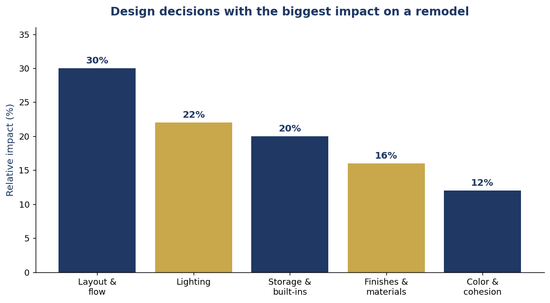
| Decision | Why it carries weight |
| Layout & flow | Shapes daily life; hardest to change later |
| Lighting | Makes every other choice look its best |
| Storage & built-ins | Determines whether the home stays uncluttered |
| Finishes & materials | The visible layer; easiest to get wrong on trend |
| Color & cohesion | Ties rooms into one considered whole |
Treat this as a guide to where attention pays off, not a rulebook. The takeaway is to spend design energy on the decisions near the top before agonizing over the ones near the bottom, because that order is how a remodel ends up feeling genuinely designed.
Why does layout matter more than finishes?
Because you can change a finish, but you live inside a layout. A poor floor plan, a kitchen that bottlenecks, a primary suite with no natural light, cannot be fixed with nicer tile. The layout is the bones, and good bones make an ordinary finish feel intentional while bad bones undermine an expensive one.
This is why a design-led remodel starts with how the home should function and feel, then chooses finishes to support that. Reversing the order, picking finishes first and forcing the layout to accommodate them, is one of the most common and most expensive mistakes homeowners make.
How much difference does lighting really make?
Enormous, and it is routinely under-budgeted. A room needs layered light: ambient light for the whole space, task light where you work, and accent light for mood. Done well, lighting makes finishes glow and a room feel finished; done poorly, a single overhead fixture leaves even a beautiful room flat and shadowed.
Lighting is also one of the best returns on a design dollar, because it is relatively inexpensive compared to its daily impact. Planning the lighting as carefully as the cabinetry or tile is a hallmark of a remodel that was actually designed rather than just decorated.
How do you design storage that keeps a home uncluttered?
Design it in from the start, sized to what you actually own. Built-ins, deep drawers, a well-planned pantry or mudroom, and dedicated homes for the things that normally pile up are what keep a renovated home looking the way it did the week it was finished.
The failure mode is treating storage as an afterthought and hoping furniture will cover the gap. Thoughtful, integrated storage disappears into the architecture and does the quiet work of keeping surfaces clear, which is a huge part of why some remodeled homes feel serene and others feel cramped within a month.
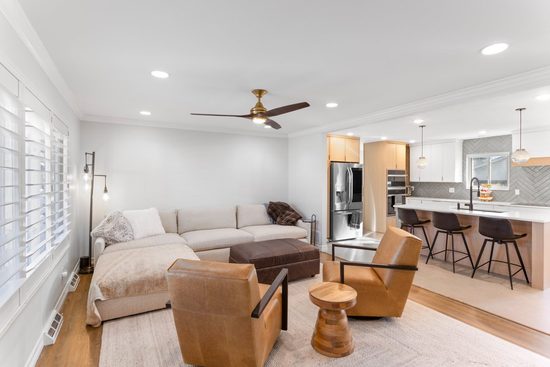
How do you choose finishes that will not date?
Keep the permanent, expensive elements timeless and save the trends for things you can easily change. Cabinetry, counters, flooring, and tile should lean classic, while paint, hardware, light fixtures, and accessories carry the of-the-moment personality that is cheap to swap in a few years.
The most regretted decisions are bold, trend-driven choices baked into permanent surfaces. Timeless bones with changeable accents is the formula that keeps a home looking current for a decade rather than announcing exactly the year it was remodeled the moment someone walks in.
What makes a home feel cohesive after a remodel?
A consistent material and color language running through the spaces. When flooring carries through, the palette relates room to room, and hardware and fixtures share a family, a home reads as one considered whole rather than a series of separately decorated rooms that happen to share an address.
Cohesion does not mean everything matches; it means everything belongs. A design-led remodel establishes a few guiding choices early, a palette, a metal, a wood tone, and lets them tie the home together, which is often the difference between a renovation that feels professional and one that feels piecemeal.
Should you open up the floor plan?
Often, but not always, and the trend should not decide it for you. Open-concept keeps people connected and makes a home feel larger, which is why it has dominated for years. But some households value defined rooms that contain mess, noise, and cooking smells, and an entirely open plan can feel loud and hard to furnish.
The middle path works for many: open the main living spaces while keeping a pantry, office, or prep area tucked out of sight. Decide based on how your household actually lives rather than the trend, because both approaches can be beautiful when matched to real daily habits.
How does good design save money?
By preventing the expensive mistakes before they happen. A well-developed design locks decisions before demolition, which is where budgets hold, and it avoids the costly mid-project changes that come from figuring things out on the fly. Deciding once, on paper, is far cheaper than deciding twice, in the field.
Design also directs money to where it matters. A clear plan spends on the layout, light, and quality that you feel every day and economizes on the accents that can change cheaply later. That discipline, more than any single material choice, is what keeps a remodel’s value high and its budget intact.
Do you need a designer and a contractor?
You need both roles covered, whether by two people or one integrated team. Design sets the vision and resolves the layout, light, and selections; construction executes it and manages the trades, permits, and hidden work. Problems most often appear in the gap between them, when the plan and the build are not talking.
That is why many homeowners prefer a remodeler who handles design and construction together, so the person planning the space is accountable to the person building it. The tighter that link, the fewer surprises, and the more faithfully the finished home matches the vision that started it.
When design and build are split across parties who do not coordinate, the plan tends to drift in the field, choices get made by whoever is on site that day, and the homeowner ends up refereeing. An integrated team closes that gap, which is why it so often produces a calmer process and a result that looks like the drawings rather than a compromise of them.
How do you choose the right remodeler?
Verify licensing and insurance, look at completed projects in person, and pay attention to how a contractor talks about layout, light, and the hidden work, not just finishes. A team that leads with the design thinking behind a project, and treats the unseen work with equal care, is the one that delivers a home that both looks and lives well.
Local experience matters for permits and for knowing how area homes are built. A team experienced in home remodeling in Greenwood Village will design around how you actually live, coordinate the trades cleanly, and deliver the kind of execution that makes a renovation feel genuinely designed rather than simply updated.
What is the most common design regret?
Chasing a trend into a permanent surface. The bold tile, the of-the-moment cabinet color, the dramatic fixture baked into the architecture all feel exciting on install day and dated within a few years. The regret is not that the choice was bold, it is that it was bold in a place that is expensive to change.
The second most common regret is ignoring function for a look, a gorgeous island with no landing space, a statement light that leaves the room dim. Design that leads with how a space works, then makes it beautiful, almost never produces these regrets, because the daily experience was the priority from the start.
How do you balance personal taste with resale?
Express personality in the layers that are easy to change and keep the permanent, expensive elements broadly appealing. Paint, art, textiles, hardware, and fixtures are where your taste can run free, because a future buyer, or future you, can swap them cheaply without touching the architecture.
The surfaces that cost real money to redo, flooring, cabinetry, counters, tile, are the ones to keep timeless and widely liked. This is not about designing for a hypothetical buyer at the expense of your own enjoyment; it is about putting the bold choices where they are reversible and the safe choices where they are not.
How do you plan a remodel that both photographs and lives well?
Design for the daily experience first and the photo will follow. Rooms that flow, fill with light, and keep clutter hidden look good in a photograph precisely because they work in life. A space staged to photograph well but awkward to live in reveals itself the moment you actually use it.
The homes that do both share the same foundations: a smart layout, layered lighting, integrated storage, and a cohesive palette. Nail those and the photos take care of themselves, because you are no longer dressing up a flawed space, you are capturing one that genuinely works.
How do you keep a design on budget?
Finalize the design before demolition and resist changing it mid-project. The most expensive words in a remodel are “while we’re at it,” and the second most expensive are “actually, let’s change.” A complete, decided design, with selections locked, is the single best protection against a budget that drifts.
Direct the money deliberately, too: spend on the layout, light, and quality you feel every day, and economize on the accents that can change cheaply later. A design that knows its own priorities spends confidently where it matters and holds the line everywhere else, which is how a remodel stays both beautiful and affordable.
The Bottom Line
A remodel is made or broken by the decisions most people overlook: layout, light, storage, and cohesion, settled before a single finish is chosen. Get those right and even modest finishes feel intentional; get them wrong and the most expensive tile in the world cannot rescue the result.
Design with discipline, spend where it shows in daily life, keep the permanent surfaces timeless, and hire a team that treats design and execution as one job. Do that, and a renovation stops being a collection of updates and becomes what people actually want: a home that feels considered, works effortlessly, and still looks right many years down the road.
The difference between a remodel that merely looks new and one that feels genuinely designed is almost never the budget; it is the order of the decisions. Homeowners who start with layout, light, storage, and cohesion, and only then choose finishes, consistently end up with homes that feel calm, intentional, and expensive to the eye regardless of what they actually spent. That order is the whole craft, and it is available to any renovation willing to plan before it picks a paint color.